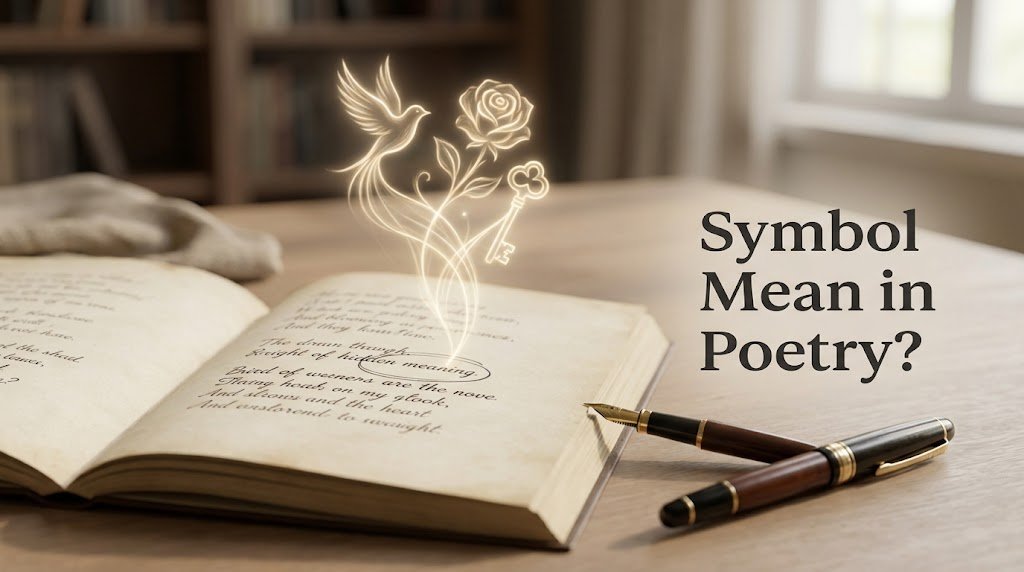
Poetry often says much more than the words on the page. A poet may write about a rose, but the rose may represent love. A storm might suggest emotional conflict. A road can represent a life journey, while darkness may suggest fear, uncertainty, or grief.
So, what does symbol mean in poetry? In simple terms, a symbol in poetry is an object, person, place, action, or image that represents a deeper idea or emotion beyond its literal meaning.
People often search this question because literary symbolism can feel confusing at first. A poem may describe an ordinary object, yet teachers, exam questions, or readers ask what that object “symbolizes.” The difficulty is knowing when something is simply part of the poem and when it carries a deeper meaning.
Understanding symbolism makes poetry much easier to read. More importantly, it helps you notice the emotional layer beneath the literal story.
What Does Symbol Mean in Poetry – Quick Meaning
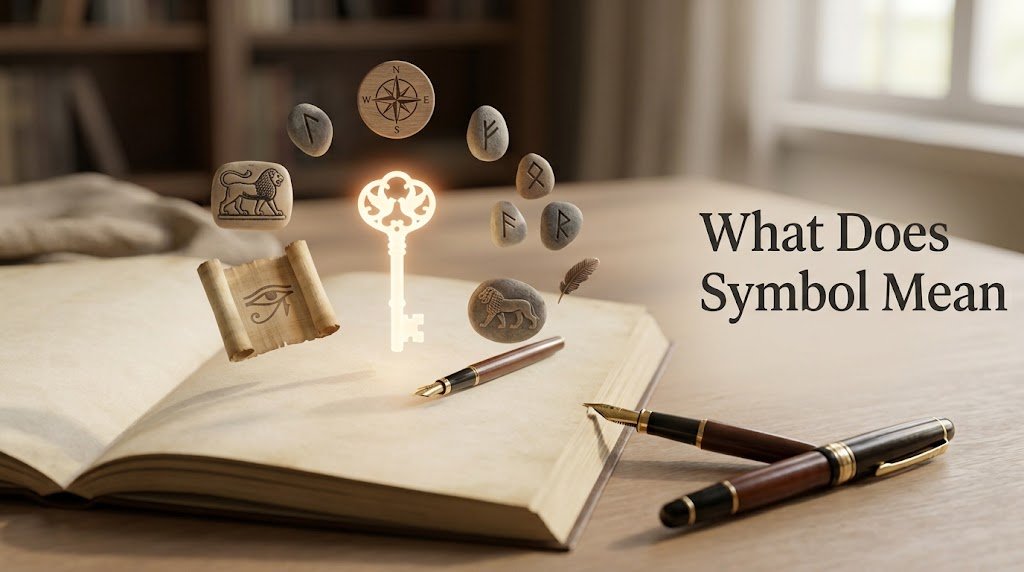
A symbol is something concrete that points toward an abstract idea.
For example:
- Rose → love, beauty, passion, or sometimes secrecy
- Winter → death, loneliness, hardship, or an ending
- Bird → freedom, hope, escape, or spiritual longing
- Road → choice, personal growth, or life’s journey
- Light → hope, knowledge, truth, or goodness
The important point is that a symbol does not have one permanent meaning.
Its meaning depends on the poem, the poet’s intention, the surrounding images, and sometimes the culture in which the poem was written.
Consider these short examples:
“She left a rose beside his photograph.”
The rose might symbolize love, remembrance, or mourning.
“I walked beneath a fading sun.”
The fading sun could symbolize an ending, aging, or loss.
“The bird refused to leave its cage.”
Here, the bird and cage together may symbolize a desire for freedom.
Symbolism works because readers recognize the physical image first and then discover the idea underneath it.
Origin & Background of Symbolism in Poetry
Symbolism is far older than modern poetry.
Human cultures have always used physical things to express ideas that are difficult to explain directly. Ancient stories, religious texts, myths, songs, paintings, and oral traditions all used objects and natural events as representations of larger concepts.
A river, for instance, has frequently represented movement, transformation, boundaries, or the passage of life. Fire has been associated with destruction, purification, passion, and spiritual energy in different traditions.
Poetry developed this technique naturally because poems often depend on compressed language. A single image can communicate something that would otherwise require several sentences of explanation.
Symbolism became particularly influential in nineteenth-century European literature through the Symbolist movement, whose writers emphasized suggestion, atmosphere, emotion, and indirect meaning.
But symbolism was never limited to Europe.
Poets across Asia, Africa, the Middle East, the Americas, and other regions have used nature, seasons, animals, colors, religious imagery, and everyday objects to communicate cultural and emotional ideas.
Modern communication has changed symbolism again.
Social media has created shared visual symbols that can cross borders almost instantly. A broken heart, black heart, butterfly, candle, moon, or white dove can carry emotional associations without requiring a long explanation.
The difference is that online symbols can change rapidly.
A symbol that feels sincere in one online community may feel ironic in another. This is why context matters so much when interpreting symbolism today.
Real-Life Conversations
Symbolic language is not restricted to poems. People use symbolic expressions constantly in everyday digital communication.
Person A:
“I still have his old hoodie.”
Person B:
“You never wear it though.”
Person A:
“I know. It just means something to me.”
Here, the hoodie has become a personal symbol of the relationship.
Instagram DMs
Person A:
“Why did you post that picture of the sunset?”
Person B:
“Because I needed a reminder that endings aren’t always bad.”
The sunset is functioning symbolically. It represents an ending, but also acceptance and transition.
TikTok Comments
Person A:
“Why does everyone keep commenting 🦋?”
Person B:
“People use the butterfly for transformation and becoming a different version of yourself.”
The butterfly has acquired symbolic meaning through cultural and internet usage.
Text Messages
Person A:
“She gave me her grandmother’s ring.”
Person B:
“That’s beautiful.”
Person A:
“Yeah. It isn’t expensive, but it feels like carrying part of my family with me.”
The ring symbolizes family history, memory, and belonging.
These examples show something important: symbolism is not only a literary technique. It is part of how humans naturally attach emotional meaning to ordinary things.
Emotional & Psychological Meaning
Why do symbols work so well?
One reason is that human beings connect experiences with objects and images.
A song can remind someone of a particular person. An old photograph can bring back an entire period of life. A childhood house can represent safety long after someone has moved away.
The object itself has not necessarily changed. Its emotional meaning has.
Poets use this psychological connection deliberately.
Instead of writing, “I am lonely because someone I loved is gone,” a poet might describe an empty chair at the dinner table.
The chair becomes emotionally powerful because readers understand what an empty place can suggest.
Symbolism can express:
- Love
- Grief
- Hope
- Fear
- Freedom
- Isolation
- Change
- Identity
- Memory
- Death
- Spirituality
- Belonging
I once encountered a poem where an ordinary window initially seemed like nothing more than part of the setting. As the poem developed, however, the window became a boundary between the speaker’s private world and the life happening outside. That shift made the poem feel far more personal.
That is one of the pleasures of symbolism: the meaning often grows as you read.
Psychologically, symbols also allow writers to discuss difficult subjects indirectly. Grief, trauma, desire, loneliness, and uncertainty can be emotionally difficult to name directly. An image gives the reader some distance while still allowing the feeling to come through.
Usage in Different Contexts
Social Media
Symbolic language is extremely common online.
A sunset may represent peace. A black-and-white photograph may suggest nostalgia. A particular flower may communicate affection or remembrance.
However, online symbolism is highly dependent on community and trends.
Friends & Relationships
People create private symbols without even realizing it.
A particular restaurant, song, nickname, photograph, or object can become meaningful because of a shared experience.
For two friends, a certain snack might symbolize childhood. For a couple, a train station might symbolize the beginning of their relationship.
Work & Professional Settings
Symbolism also appears in professional communication, although it should usually be clearer.
For example, a company may use an open door to symbolize opportunity or a bridge to represent cooperation.
However, professional writing should not rely heavily on ambiguous symbolism when the reader needs precise information.
Casual vs. Serious Tone
Symbolism can make casual language playful:
“The coffee machine is basically my office therapist.”
It can also make serious writing emotionally powerful:
“The empty chair remained at the table.”
The first is humorous and figurative. The second invites emotional interpretation.
When NOT to Use It
Symbolism is powerful, but it is not appropriate everywhere.
Avoid heavy symbolism when:
- Giving emergency instructions
- Explaining technical procedures
- Writing legal or contractual information
- Communicating an important deadline
- Giving safety instructions
- Discussing sensitive professional matters where clarity is essential
Cultural sensitivity also matters.
A color, animal, gesture, or object can carry very different meanings in different cultures. Assuming that every reader will interpret a symbol exactly as you intended can lead to misunderstanding.
For example, colors associated with mourning, celebration, purity, or good fortune vary across cultures.
When the message matters more than artistic expression, direct language is usually safer.
Common Misunderstandings
Every object is automatically a symbol
Not necessarily.
If a poem mentions a chair, the chair may simply be a chair. Look for repetition, unusual emphasis, contrast, imagery, or connections to the poem’s central theme before deciding that something is symbolic.
Symbols always have one meaning
They don’t.
A snake might symbolize danger in one poem but transformation or healing in another cultural context.
The dictionary gives you the symbolic meaning
A dictionary gives you the literal meaning of a word. Literary interpretation requires context.
Symbolism is the same as metaphor
They are related but not identical.
A metaphor directly compares one thing with another to create meaning. A symbol uses something concrete to represent a broader idea.
The poet’s intention is the only possible interpretation
Not always.
A thoughtful interpretation should be supported by the poem, but readers can sometimes discover meanings beyond what the writer consciously intended.
Comparison Table
| Expression | Meaning | How it differs from a symbol |
|---|---|---|
| Symbol | Represents a deeper idea | Uses an image or object to suggest meaning |
| Metaphor | Directly compares two things | Creates comparison rather than simply representing an idea |
| Simile | Compares using “like” or “as” | Makes the comparison explicit |
| Allegory | A larger story represents another idea | Usually operates across an entire narrative |
| Imagery | Creates sensory pictures | Focuses on what readers see, hear, feel, taste, or smell |
| Motif | Repeated image or idea | Becomes significant through repetition |
| Literal meaning | Direct, surface meaning | Says exactly what the words describe |
| Irony | Meaning contrasts with expectation | Creates tension between appearance and reality |
| Antonym/opposite | Expresses a contrasting idea | Opposes meaning rather than representing it |
Key Insight
A symbol is best understood through context, not a fixed list of meanings. The same object can represent completely different emotions in different poems, cultures, or situations.
Variations / Types of Symbols
1. Natural Symbols
These come from nature.
Example: A storm may symbolize conflict, emotional turmoil, or danger.
2. Cultural Symbols
These depend on shared cultural knowledge.
Example: A national flag can symbolize identity, belonging, history, or political ideals.
3. Religious Symbols
These draw meaning from religious traditions.
Example: A cross may represent Christianity, sacrifice, faith, or redemption.
4. Personal Symbols
These develop from an individual’s experiences.
Example: An old house may symbolize childhood or security for one person.
5. Universal Symbols
These have relatively widespread associations across cultures.
Example: Light is frequently connected with hope, knowledge, or goodness.
6. Conventional Symbols
These gain meaning through social agreement.
Example: A wedding ring commonly symbolizes commitment or marriage.
7. Literary Symbols
These are deliberately developed within a poem, story, or other literary work.
Example: A recurring river might represent change throughout an entire poem.
8. Color Symbols
Colors can carry emotional or cultural associations.
Example: Red may suggest love, anger, passion, danger, or political identity depending on context.
9. Animal Symbols
Animals often represent human qualities.
Example: A lion may suggest courage or power.
10. Object Symbols
Everyday objects can acquire deeper emotional significance.
Example: A locked door may represent isolation, secrecy, limitation, or an opportunity that remains inaccessible.
How to Respond When Someone Uses It
If someone uses symbolic language in conversation, your response should match the emotional situation.
Casual Replies
- “I get what you mean.”
- “That’s actually a pretty good symbol.”
- “Yeah, I can see the connection.”
Funny Replies
- “So the coffee is officially a symbol of survival now?”
- “Okay, Shakespeare, I see you.”
- “That escalated from a sunset to a life lesson pretty quickly.”
Mature Replies
- “I understand why that image means so much to you.”
- “That sounds like it represents more than the object itself.”
- “I hadn’t thought about it that way, but I see your point.”
Respectful Replies
- “Thanks for explaining what it means to you.”
- “I can understand why you connect that image with that experience.”
- “That’s a meaningful interpretation.”
The safest approach is not to assume what a personal symbol means. Ask when necessary.
Regional & Cultural Usage
Symbolism changes significantly across cultures.
Western Culture
In many Western literary traditions, images such as roses, roads, seasons, birds, darkness, and light have long-established associations.
However, modern Western writers frequently challenge these conventions and give familiar symbols unexpected meanings.
Asian Culture
Asian literary traditions contain rich symbolic systems involving nature, seasons, flowers, animals, colors, landscapes, and spiritual concepts.
For example, particular flowers can carry meanings connected with purity, impermanence, beauty, mourning, or spiritual development depending on the cultural tradition.
The important lesson is not to assume that a symbol means exactly the same thing everywhere.
Middle Eastern Culture
Poetry across Middle Eastern traditions has developed sophisticated symbolic language involving gardens, night, wine, deserts, birds, journeys, and beloved figures.
Some symbols can have both worldly and spiritual interpretations, particularly within traditions influenced by mystical poetry.
Global Internet Usage
Online culture constantly creates and reshapes symbols.
An emoji, image, phrase, or color can gain a meaning that is completely different from its traditional interpretation.
Internet communities can also use symbols ironically. A symbol may mean one thing sincerely and something completely different as a joke.
Gen Z vs. Millennials
Generational differences can affect symbolic communication.
Gen Z communication often moves quickly between text, emojis, memes, images, slang, and irony. Millennials may recognize many of the same symbols but interpret certain internet expressions differently depending on their online experiences.
Neither generation has a single universal language.
Context, community, age, and personal experience all matter.
Is It Safe for Kids?
Yes, understanding symbols in poetry is generally safe and educational for children.
In fact, symbolism can help young readers develop reading comprehension, emotional vocabulary, creativity, and critical-thinking skills.
The key is age-appropriate context.
A child might begin with simple examples such as a sun representing happiness or a rainbow representing hope. Older students can gradually explore more complex symbolism involving grief, identity, conflict, death, politics, or spirituality.
Parents and teachers should encourage children to explain why they think an object represents a particular idea rather than simply memorizing symbolic meanings.
FAQs
What is a symbol in poetry?
A symbol in poetry is an object, image, person, place, or action that represents a deeper idea beyond its literal meaning.
What is an example of symbolism in poetry?
A rose can symbolize love, beauty, passion, or remembrance. Its exact meaning depends on the poem’s context.
Is symbolism the same as metaphor?
No. A metaphor makes a comparison between two things, while a symbol represents a broader idea or emotion.
Can one symbol have multiple meanings?
Yes. A symbol can have different meanings depending on the poem, culture, context, and reader.
How do you identify a symbol in a poem?
Look for objects or images that receive unusual emphasis, appear repeatedly, connect to the poem’s main theme, or seem to carry emotional meaning beyond their literal role.
Why do poets use symbols?
Poets use symbols to express complex emotions and ideas indirectly, allowing readers to discover meaning rather than receiving every message explicitly.
Do symbols have the same meaning in every culture?
No. Symbolic meanings can differ significantly across cultures, religions, generations, and communities.
Conclusion
So, what does symbol mean in poetry? It means using something recognizable—a flower, road, bird, window, storm, color, object, or place—to communicate something deeper. The beauty of symbolism is that it allows poetry to speak on more than one level. You can read about a road and see a road. Then you can read it again and realize that the poet may be talking about choice, regret, freedom, or the direction of a person’s life.
There is no need to memorize a giant dictionary of symbols. Instead, pay attention to context. Ask what the image literally is, what emotions surround it, whether it repeats, and how it connects to the poem’s larger message. Most importantly, don’t be afraid to interpret. A strong reading of poetry is not about guessing the “secret answer.” It is about finding a thoughtful interpretation and supporting it with evidence from the words on the page.
That is where poetry becomes personal. The poet gives you the image; your experience helps you discover what it can mean.
Discover more post
Symbol That Mean Dream in 2026
What Does the Red Airbag Symbol Mean? 2026
Mean of Sample Symbol What Does x̄ Mean in Statistics?2026

Dan Brown is a professional content writer and symbolism researcher with over 6 years of experience in decoding symbols, signs, emojis, dreams, colors, and cultural meanings. He specializes in creating well-researched, easy-to-understand, and SEO-friendly content that helps readers discover the true meaning behind everyday symbols. As a lead contributor at SymbolSignn.com, Dan combines extensive research with practical insights to deliver accurate, engaging, and trustworthy articles. His mission is to make complex symbolic meanings simple, reliable, and accessible for readers around the world.