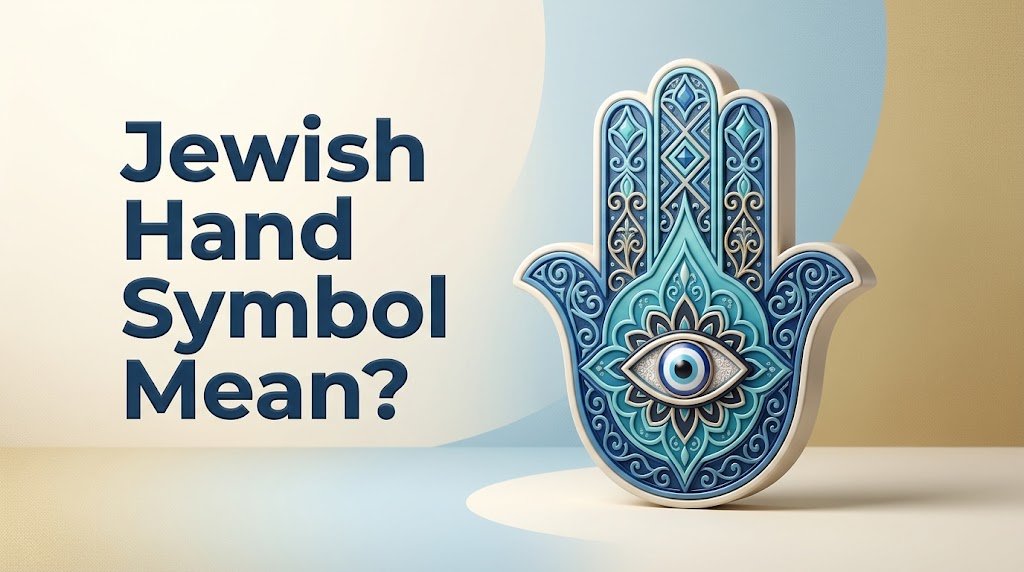
If you have seen a hand-shaped necklace, wall decoration, bracelet, tattoo, or social-media image and wondered, “What does the Jewish hand symbol mean?”, you are probably looking at the Hamsa.
The Hamsa is a palm-shaped symbol associated with protection, blessing, good fortune, and protection from the “evil eye.” It is especially familiar in Jewish communities from the Middle East and North Africa, although it is not exclusively Jewish. The symbol also has a long history in Muslim cultures and appears across the wider Middle Eastern and North African region.
That shared history is one reason the Hamsa can be confusing. Some people call it the Hand of Miriam, while others know it as the Hand of Fatima. In other settings, it is simply called the Hamsa or Hand of Protection.
Understanding the symbol means looking beyond its shape. Its meaning can change according to the community, context, design, and personal intention behind it.
What Does the Jewish Hand Symbol Mean? – Quick Meaning
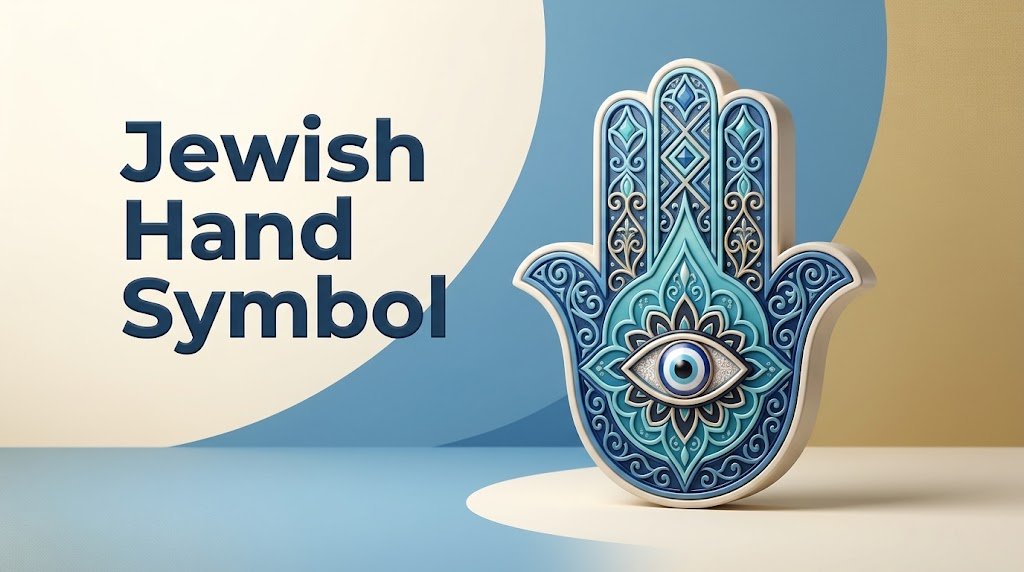
In Jewish contexts, the Hamsa is commonly understood as a symbol of protection, blessing, good luck, and defense against the evil eye.
The word Hamsa comes from the Arabic word for five, referring to the five fingers of the hand.
A Jewish Hamsa may be associated with Miriam, the sister of Moses and Aaron, although this interpretation is part of later Jewish tradition rather than a simple biblical identification of the Hamsa itself.
In everyday use, the symbol may communicate ideas such as:
- Protection: A wish to keep harm away.
- Blessing: A visual expression of good wishes.
- Good fortune: A hope for positive circumstances.
- Protection from the evil eye: A traditional concern found in several cultures.
- Jewish or Middle Eastern heritage: For some people, wearing it is also a cultural statement.
You might hear someone explain it naturally like this:
“My grandmother gave me this Hamsa for protection.”
“I wear it because it reminds me of my family.”
“It’s a symbol of blessing and keeping negative energy away.”
These examples also show something important: the Hamsa does not have one universal meaning for every Jewish person.
Origin & Background
The history of the Hamsa is older and broader than any single modern religious label.
Hand symbols have appeared in ancient cultures across the Middle East and North Africa. Over centuries, hand imagery became connected with ideas such as protection, divine blessing, strength, and warding off harmful influences.
The Jewish connection became particularly prominent among Jewish communities with roots in places such as North Africa, the Middle East, and the Mediterranean.
For these communities, the Hamsa became part of everyday visual culture. It could appear in jewelry, household decorations, amulets, artwork, and ceremonial objects.
The association with Miriam developed within Jewish tradition. Miriam is an especially meaningful biblical figure: she was the sister of Moses and Aaron and is remembered for her leadership, courage, and connection with the Israelites during the Exodus.
Some Jewish interpretations therefore call the Hamsa the Hand of Miriam.
At the same time, it is important not to present this as though the Hebrew Bible explicitly identifies a Hamsa as Miriam’s symbol. The biblical connection and the physical symbol belong to different layers of history and tradition.
The Hamsa is also strongly associated with Muslim traditions, where it is often called the Hand of Fatima, referring to Fatima, the daughter of Muhammad.
This overlapping cultural history is especially important when discussing the symbol today. Calling it exclusively Jewish or exclusively Muslim oversimplifies a symbol that has traveled across communities for centuries.
Social media has made that complexity even more visible.
Pinterest, Instagram, TikTok, and online jewelry stores frequently use terms such as “Jewish Hamsa,” “Miriam’s Hand,” “Hand of Fatima,” and “evil-eye protection” interchangeably. That can introduce the symbol to people who have never encountered it in its original cultural setting.
As a result, the Hamsa has gradually developed two identities for many modern users: a traditional cultural symbol and a contemporary decorative symbol.
For some people, it remains deeply meaningful. For others, it is simply beautiful jewelry. And for many, it is both.
Real-Life Conversations
Person A:
“Your necklace is so pretty. Is that a Jewish symbol?”
Person B:
“Yeah, it’s a Hamsa. My family calls it Miriam’s Hand.”
Person A:
“What does it mean?”
Person B:
“Protection and blessing, mostly. My grandmother always kept one in her home.”
The emotional detail here matters. For Person B, the Hamsa is not merely an accessory. It connects a modern object with family memory.
Instagram DMs
Person A:
“I keep seeing this hand symbol on Jewish jewelry. Does it mean good luck?”
Person B:
“Kind of. It’s usually connected with protection and the evil eye.”
Person A:
“Ohhh, so it’s not just a fashion symbol?”
Person B:
“Not necessarily. It depends on the person wearing it. For some people it’s cultural, for others it’s religious or spiritual.”
That last distinction is useful because symbols often carry several meanings simultaneously.
TikTok Comments
Person A:
“Is the Hamsa Jewish or Muslim?”
Person B:
“Both traditions use it, but they can explain it differently.”
Person A:
“So it’s not exclusive to one religion?”
Person B:
“Right. It’s a shared symbol with different cultural interpretations.”
This is a good example of why quick social-media explanations can be misleading. A symbol can belong meaningfully to more than one cultural tradition.
Text Messages
Person A:
“Mom gave me a Hamsa necklace before I moved.”
Person B:
“That is actually really sweet.”
Person A:
“She said it was for protection.”
Person B:
“Sounds like she wanted you to carry a little piece of home with you.”
Sometimes the emotional meaning of a symbol is more important to its owner than its historical definition.
Emotional & Psychological Meaning
Why do people connect so strongly with a simple hand?
Part of the answer is psychological. Humans naturally attach meaning to objects that represent safety, belonging, memory, and hope.
A Hamsa can become a portable reminder of protection.
Someone might wear one before traveling, during an important life change, after moving away from family, or simply because it reminds them of a parent or grandparent.
The hand itself is also a powerful human image. We use hands to comfort, welcome, bless, create, protect, and communicate.
That makes a hand-shaped symbol emotionally intuitive even before someone knows its cultural history.
The concept of the evil eye adds another layer. Across various cultures, people have historically expressed concern that envy, excessive admiration, or malicious attention could bring misfortune. Protective symbols offered a way of expressing the desire to stay safe from that perceived harm.
In modern communication, the Hamsa can therefore function almost like a visual form of reassurance.
Imagine a friend leaving home for a new country. Her mother gives her a small Hamsa pendant and says, “Keep this with you.”
The pendant may not literally change what happens during the journey. Its emotional value lies somewhere else: it carries the mother’s care into a place where the mother cannot physically be present.
That is one reason cultural symbols survive even as societies change.
Usage in Different Contexts
Social Media
On Instagram, TikTok, and other platforms, a Hamsa may appear in photographs, captions, jewelry posts, tattoos, or lifestyle content.
The intended message might be protection, spirituality, heritage, or simply appreciation for the design.
Context matters. A Hamsa displayed alongside Hebrew text or Jewish family traditions will usually communicate something different from a fashion photograph using the symbol purely as decoration.
Friends & Relationships
Among friends, the symbol can be connected with affectionate messages such as wishing someone safety or good luck.
Someone might give a Hamsa necklace to a friend who is traveling, starting university, moving house, or beginning a new relationship.
In this setting, the symbol can become a physical expression of care.
Work & Professional Settings
The Hamsa is generally not offensive in a workplace simply because it is visible.
However, professional settings require cultural awareness. If you are discussing its meaning in a presentation, article, or marketing campaign, avoid confidently claiming that the Hamsa belongs exclusively to Judaism.
A more accurate explanation recognizes its multiple cultural traditions.
Casual vs. Serious Tone
In casual conversation, saying “It’s a symbol of protection” is usually enough.
In academic, religious, journalistic, or educational writing, greater precision is appropriate. Explain that the Hamsa has Jewish, Muslim, and broader Middle Eastern and North African associations, with different interpretations developing within different communities.
When NOT to Use It
The Hamsa is not inherently inappropriate, but careless use can create problems.
Avoid presenting it as an exclusively Jewish symbol when discussing its broader history.
Likewise, avoid claiming that every Jewish person believes the Hamsa provides supernatural protection. Jewish communities are diverse, and individual beliefs vary widely.
Be particularly careful when using the symbol commercially.
Selling a Hamsa as a generic “Jewish good-luck charm” may flatten a complex cultural tradition into a marketing slogan.
It is also wise to avoid making jokes about the evil eye, Miriam, Fatima, or religious protection when speaking with someone who treats these traditions seriously.
A little cultural humility goes a long way.
Common Misunderstandings
“The Hamsa is only Jewish.”
No. Jewish communities use the Hamsa, but it is also deeply associated with Muslim traditions and broader regional cultures.
“Every Hamsa means exactly the same thing.”
Not necessarily. Its meaning depends on the cultural and personal context.
“The Hamsa and the evil eye are the same symbol.”
They are related in some popular usage but are not identical.
The Hamsa is the hand-shaped symbol. The evil eye is a broader belief concerning harmful effects associated with envy or a malevolent gaze. Different cultures have developed different protective symbols around that concept.
“It is just jewelry.”
Sometimes it is.
But for another person, that same necklace may represent family history, religious tradition, migration, protection, or a connection to grandparents.
The object may look decorative while carrying considerable emotional weight.
Comparison Table
| Expression or Symbol | Main Meaning | Typical Tone |
|---|---|---|
| Hamsa | Protection, blessing, good fortune | Cultural / spiritual |
| Miriam’s Hand | Jewish association with protection and Miriam | Jewish / cultural |
| Hand of Fatima | Protection and blessing in Islamic cultural contexts | Muslim / cultural |
| Evil eye | Harm associated with envy or a harmful gaze | Traditional / cultural |
| Lucky charm | Object associated with good fortune | Casual |
| Blessing | Wish for protection or positive outcomes | Warm / serious |
| Good luck | Hope that things go well | Casual |
| Protective amulet | Object believed to guard against harm | Traditional |
| Crossed fingers | Hope that something works out | Informal |
| “Stay safe” | Direct expression of concern and care | Modern / conversational |
Key Insight
The Hamsa is best understood as a symbol whose meaning changes with cultural context, rather than as a single code with one fixed definition. Its strongest recurring themes are protection, blessing, heritage, and hope.
Variations / Types
1. Open-Palm Hamsa
A straightforward hand design with an open palm, commonly associated with protection and blessing.
2. Hamsa with an Eye
The palm contains an eye, connecting the hand visually with protection against the evil eye.
3. Miriam’s Hand
A Jewish interpretation that connects the symbol with Miriam, the biblical sister of Moses and Aaron.
4. Hand of Fatima
A Muslim cultural interpretation associated with Fatima, the daughter of Muhammad.
5. Symmetrical Hamsa
Both sides of the hand may look similar, creating a stylized design that is especially common in jewelry and decorative art.
6. Hamsa with Hebrew Letters
Some Jewish versions incorporate Hebrew words, letters, or phrases associated with blessing, protection, or faith.
7. Hamsa Necklace
A wearable version often given as a meaningful gift or used as a cultural accessory.
8. Hamsa Bracelet
A smaller design that can be worn every day and may be chosen for personal or family reasons.
9. Decorative Wall Hamsa
A Hamsa displayed in a home, sometimes as a cultural decoration and sometimes as a traditional protective symbol.
10. Contemporary Artistic Hamsa
Modern designers may reinterpret the hand using minimalist shapes, gemstones, colors, or abstract patterns.
How to Respond When Someone Uses It
If someone sends you a Hamsa emoji, image, necklace photo, or reference to the symbol, your response should match the situation.
Casual Replies
- “That’s a beautiful Hamsa!”
- “I love the design.”
- “Is that your family’s symbol?”
Funny Replies
- “Protection mode: activated.”
- “Okay, I see you keeping the bad vibes away!”
- “That hand has a serious job.”
Use humor only when you already have a comfortable relationship with the person.
Mature Replies
- “I know it’s associated with protection and the evil eye. Does it have a personal meaning for you?”
- “I’ve seen different interpretations of the Hamsa. Which tradition does yours come from?”
These responses show curiosity without making assumptions.
Respectful Replies
- “That’s meaningful. Thank you for explaining it.”
- “I appreciate the cultural background behind it.”
- “I can see why that would be important to you.”
The best response is often simply to let the person explain what the symbol means to them.
Regional & Cultural Usage
Western Culture
In Western countries, the Hamsa is often encountered through jewelry, interior design, tattoos, wellness culture, and social media.
Some people understand its cultural background, while others encounter it primarily as a symbol of protection or a fashionable design.
That difference can occasionally lead to misunderstandings about its religious significance.
Asian Culture
In parts of Asia, protective amulets and symbolic objects are already familiar cultural concepts, although their meanings differ from those of the Hamsa.
A person may therefore recognize the general idea of a protective symbol while not immediately understanding the Hamsa’s Jewish or Middle Eastern background.
It is important not to assume that similar-looking symbols have identical histories.
Middle Eastern Culture
The Hamsa has particularly strong cultural resonance across parts of the Middle East and North Africa.
Jewish and Muslim communities have both used hand imagery, while local traditions have influenced how the symbol is named, decorated, and interpreted.
For someone from the region, the Hamsa may feel less like an exotic symbol and more like a familiar part of everyday cultural life.
Global Internet Usage
Online, the Hamsa has become much more portable.
A person in New York can buy a necklace inspired by a North African Jewish design, while someone in London may discover the symbol through an Instagram post and associate it with “protection from negative energy.”
This global circulation can increase appreciation, but it can also remove the symbol from its original context.
Generational Differences: Gen Z vs. Millennials
Younger users often encounter the Hamsa through visual platforms such as TikTok, Instagram, Pinterest, and fashion communities.
Millennials may be more likely to have encountered it through jewelry, travel, home décor, or family traditions.
Neither generation has one universal interpretation.
The major difference is often where the person learned the symbol’s meaning.
Is It Safe for Kids?
Yes, generally. A Hamsa is a cultural and religious symbol rather than something inherently dangerous.
For children, the most useful approach is to explain its meaning in age-appropriate language: “Some people use this hand symbol to represent protection, blessing, or good wishes.”
Parents and teachers can also use it as an opportunity to teach cultural respect.
The key is not to tell children that every Hamsa has one meaning or that everyone who sees it will interpret it the same way.
FAQs
1. What does the Jewish hand symbol mean?
The Jewish Hamsa commonly represents protection, blessing, good fortune, and protection from the evil eye. It may also symbolize Jewish or Middle Eastern heritage.
2. Is the Hamsa a Jewish symbol?
Yes, the Hamsa is used in Jewish communities, particularly those with Middle Eastern and North African heritage. However, it is not exclusively Jewish and is also important in Muslim traditions.
3. What is the Hand of Miriam?
The Hand of Miriam is a Jewish interpretation of the Hamsa that associates the hand with Miriam, the sister of Moses and Aaron.
4. Is the Hamsa the same as the evil eye?
No. The Hamsa is a hand-shaped symbol. The evil eye refers to a broader traditional belief concerning harmful effects associated with envy or a malevolent gaze.
5. Can Jewish people wear a Hamsa?
Yes. Many Jewish people wear Hamsa jewelry or display Hamsa designs as expressions of heritage, protection, blessing, or cultural identity.
6. Is the Hamsa religious or cultural?
It can be either, or both. Some people treat it as a meaningful religious or traditional symbol, while others use it mainly as a cultural or decorative object.
7. What does the Hamsa mean on social media?
On social media, it often communicates protection, positive energy, good wishes, cultural identity, or a desire to ward off negativity. The exact meaning depends on context.
Conclusion
So, what does the Jewish hand symbol mean? In Jewish contexts, the Hamsa is commonly associated with protection, blessing, good fortune, and the hope of being shielded from the evil eye. For some Jewish communities, particularly those with Middle Eastern and North African roots, it also carries a powerful sense of heritage and family continuity.
But the most accurate explanation does not stop at “Jewish symbol.” The Hamsa has crossed cultural and religious boundaries for centuries. It has been interpreted through Jewish and Muslim traditions and has become part of the broader visual culture of the Middle East and North Africa.
That shared history is what makes the symbol so interesting. A small hand can represent a grandmother’s blessing, a family’s heritage, a personal reminder to feel protected, or simply a beautiful piece of jewelry. Its meaning is not always visible from the outside. And that is perhaps the most useful lesson when encountering cultural symbols: look beyond the object and ask what it means to the person who carries it.
When you do that, a simple hand becomes something much more human a connection between tradition, identity, memory, and hope.
Discover more post
What Does the Cloud Symbol Mean in One Drive? 2026
What Does the Apple Symbol Mean?2026
What Does Toyota Symbol Mean? 2026

Dan Brown is a professional content writer and symbolism researcher with over 6 years of experience in decoding symbols, signs, emojis, dreams, colors, and cultural meanings. He specializes in creating well-researched, easy-to-understand, and SEO-friendly content that helps readers discover the true meaning behind everyday symbols. As a lead contributor at SymbolSignn.com, Dan combines extensive research with practical insights to deliver accurate, engaging, and trustworthy articles. His mission is to make complex symbolic meanings simple, reliable, and accessible for readers around the world.