Have you ever seen someone raise their index finger and pinky finger at a concert and wondered what they were trying to say? The “rock on” hand sign is one of the world’s most recognizable gestures, yet many people don’t know where it came from or what it truly means.
If you’ve searched for what does the rock on symbol mean, you’re probably looking for more than a simple definition. Depending on where it’s used, this gesture can represent rock music, excitement, confidence, celebration, friendship, or even carry completely different meanings in other cultures. Understanding the context makes all the difference.
Featured Snippet
The rock on symbol is a hand gesture made by extending the index finger and little finger while folding the middle and ring fingers toward the palm. In most situations, it represents rock music, enthusiasm, confidence, celebration, and solidarity among fans. However, its meaning can change depending on the culture, country, or context in which it is used.
What Does the Rock On Symbol Mean?
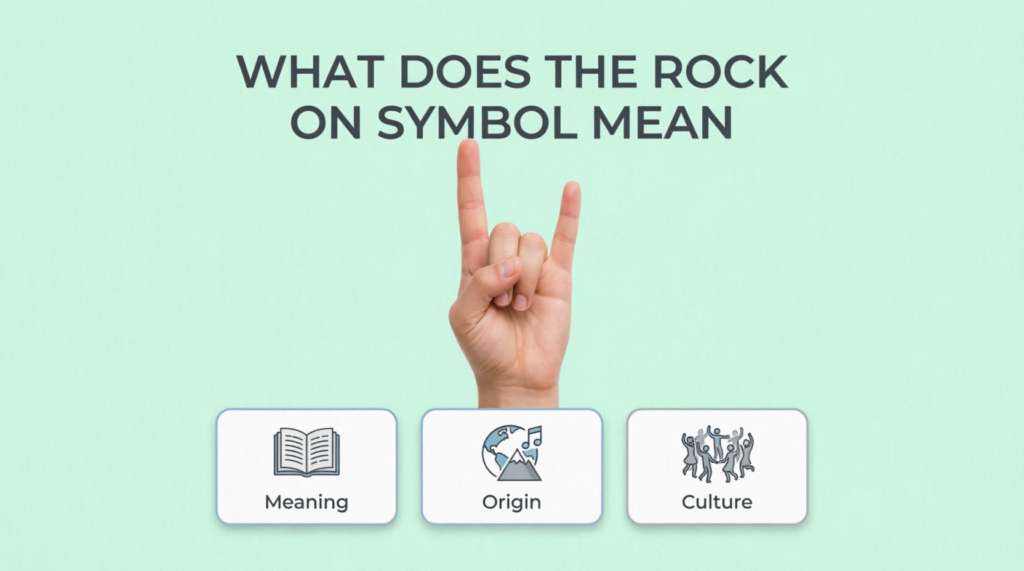
The rock on symbol, often called the devil horns, horns hand sign, or simply the rock hand gesture, is most commonly associated with rock and heavy metal music.
To make the gesture:
- Extend your index finger.
- Extend your little (pinky) finger.
- Fold your middle and ring fingers.
- Hold the thumb against those folded fingers (or slightly extended, depending on the variation).
Today, most people use it to express:
- Love for rock or metal music
- Excitement during live performances
- Energy and enthusiasm
- Celebration
- Unity among fans
- A carefree, rebellious attitude
For millions of people, it’s simply a fun way to say, “Rock on!”
However, this same hand sign doesn’t always mean the same thing everywhere. In some countries and traditions, it carries completely different cultural or symbolic meanings. That’s why understanding the setting is important before interpreting it.
A Quick Meaning at a Glance
| Context | Meaning |
|---|---|
| Rock concerts | Support for rock and metal music |
| Music festivals | Excitement and shared energy |
| Friends and celebrations | Fun, enthusiasm, or encouragement |
| Sports events | Team spirit and celebration |
| Popular culture | Confidence or rebellion |
| Certain countries | Can have different traditional meanings depending on local customs |
Where Did the Rock On Symbol Come From?
Although many people assume the gesture began with rock music, its story is much older.
Hand gestures featuring raised fingers have appeared in different civilizations for thousands of years. Similar signs were used in parts of Europe, the Mediterranean, and South Asia, often with meanings unrelated to music.
Historically, similar horn-shaped hand gestures have been used to:
- Ward off bad luck
- Protect against the “evil eye”
- Represent horns in folklore
- Express symbolic strength
- Communicate silently through gestures
These older traditions existed long before electric guitars or heavy metal bands.
How It Became Connected to Rock Music
The gesture became famous in the rock world during the late 1970s and early 1980s.
Heavy metal vocalist Ronnie James Dio is widely credited with popularizing the hand sign among rock audiences. After joining the band Black Sabbath, Dio regularly flashed the gesture during performances.
According to Dio, he learned the sign from his Italian grandmother, who used it as a traditional gesture believed to help protect against the evil eye. Rather than using it for protection on stage, Dio transformed it into a symbol of connection between performers and fans.
Because millions of concertgoers copied the gesture, it soon became one of rock music’s most recognizable symbols.
It’s important to note that while Dio popularized the sign within rock culture, he did not invent the gesture itself.
Why Do People Use the Rock On Symbol?
People flash the rock on sign for many different reasons. In everyday life, the gesture usually communicates emotion rather than a literal message.
Common reasons include:
Showing Love for Rock Music
This is by far the most recognizable use.
Fans often raise the sign when:
- Watching live concerts
- Singing along
- Greeting fellow fans
- Taking concert photos
- Celebrating favorite bands
It has become a visual shorthand for the rock community.
Expressing Excitement
The gesture also communicates high energy.
Someone might use it when:
- Winning a game
- Celebrating good news
- Starting a road trip
- Watching fireworks
- Enjoying a festival
In these situations, it simply means, “This is awesome!”
Building a Sense of Community
Music has a unique way of bringing strangers together.
At concerts, thousands of people may raise the same hand sign at once. The gesture creates an instant feeling of belonging, even among people who have never met before.
Instead of words, it says:
- “We’re enjoying this together.”
- “We’re fans.”
- “Let’s celebrate.”
Showing Confidence
Some people use the gesture in photos or social media posts to express confidence, boldness, or a carefree attitude.
In these cases, it represents personality rather than music alone.
What Does the Rock On Symbol Represent?
Like many symbols, the rock on gesture has both literal and symbolic meanings.
| Symbolic Idea | What It Represents |
|---|---|
| Freedom | Living life on your own terms |
| Energy | Passion and excitement |
| Confidence | Self-belief and boldness |
| Unity | Shared identity among fans |
| Celebration | Enjoying memorable moments |
| Individuality | Expressing your personal style |
| Rebellion | Challenging expectations in a positive, creative way |
These meanings have developed naturally through decades of use rather than being officially assigned.
Different Meanings Depending on the Context
One reason people search for this gesture is because they’ve seen it used in different situations.
That’s because context changes everything.
At a Rock Concert
The meaning is almost always positive.
It signals:
- Appreciation for the performers
- Enthusiasm
- Musical passion
- Shared excitement
No hidden message is usually intended.
In Everyday Conversation
Friends may flash the sign while:
- Taking selfies
- Celebrating achievements
- Saying “Rock on!”
- Encouraging someone
Here, it’s simply an upbeat gesture.
In Popular Entertainment
Movies, television, sports, and advertising often use the rock on sign as a visual shortcut for:
- High energy
- Coolness
- Confidence
- Youth culture
- Live entertainment
Because it’s so widely recognized, audiences immediately associate it with excitement.
In Different Cultures
Outside North America, the same hand gesture may carry traditional meanings that have nothing to do with music.
In some regions, it has historically been linked to folklore, protection from bad luck, or symbolic horns. In others, it may even be considered rude or offensive when directed at another person.
For that reason, it’s always wise to consider local customs before using the gesture while traveling.
Rock On Symbol vs. “I Love You” Hand Sign
Many people confuse the rock on gesture with the “I Love You” sign from American Sign Language because they look similar at first glance.
| Feature | Rock On Symbol | “I Love You” Sign |
|---|---|---|
| Index finger | Extended | Extended |
| Pinky finger | Extended | Extended |
| Thumb | Usually folded or against the fingers | Extended outward |
| Meaning | Rock music, celebration, enthusiasm | “I love you” in American Sign Language |
| Primary use | Music and popular culture | Communication in ASL |
The position of the thumb is the easiest way to tell them apart. In the ASL sign for “I love you,” the thumb is extended, while the traditional rock on gesture usually keeps the thumb tucked against the folded fingers.
Using the correct gesture helps avoid confusion, especially when communicating with members of the Deaf community.
Cultural Meanings of the Rock On Symbol
Although the rock on hand sign is closely tied to music in the United States, its meaning isn’t universal. The same gesture has taken on different interpretations around the world based on local traditions, history, and customs.
In the United States
For most Americans, the gesture is a positive expression associated with:
- Rock and heavy metal music
- Live concerts
- Celebration
- Excitement
- Team spirit
- Personal confidence
You’ll often see it at music festivals, sporting events, motorcycle rallies, and even graduation celebrations. In these settings, it rarely carries a negative meaning.
In Italy
Long before it became famous in rock music, a similar hand gesture appeared in Italian folk traditions.
Known as the mano cornuta (“horned hand”), it has historically been used in different ways depending on how it’s directed and the situation. Some people believed it could help ward off the “evil eye” or bad luck. Others used it as a symbolic gesture in regional folklore.
These traditional meanings are separate from its modern use at concerts.
In Spain, Portugal, and Parts of Latin America
In some Spanish- and Portuguese-speaking regions, pointing the horn gesture directly at another person may be interpreted as an insult. Historically, it has been associated with accusations of infidelity or ridicule.
Because customs vary from one country to another, travelers should avoid assuming the gesture has the same friendly meaning it does in the United States.
Around the World
Global music culture has made the rock on symbol widely recognizable, but local traditions still matter. A gesture that feels harmless in one country can be misunderstood in another.
When in doubt, pay attention to how local people use the sign before using it yourself.
The Psychological Meaning of the Rock On Symbol
Hand gestures communicate emotions without saying a word, and the rock on symbol is no exception.
Psychologically, people often use this gesture to express feelings they want others to notice instantly.
Common emotional associations include:
- Confidence
- Excitement
- Joy
- Freedom
- Belonging
- Personal identity
- Courage
At a concert, thousands of fans raising the same hand sign creates a shared emotional experience. Social psychologists describe this kind of synchronized behavior as something that strengthens group identity and social connection.
The gesture can also help people express enthusiasm when words don’t seem strong enough.
Does the Rock On Symbol Have a Spiritual Meaning?
The answer depends on who you ask.
There is no single spiritual meaning accepted by all religions or cultures. Instead, several interpretations exist.
Historical Folk Beliefs
In parts of Southern Europe, similar horn-shaped gestures were traditionally believed to provide protection against bad luck or the evil eye.
These beliefs come from local folklore rather than organized religious teachings.
Modern Spiritual Views
Some people see the gesture as representing:
- Personal strength
- Inner confidence
- Positive energy
- Protection
- Fearlessness
These interpretations are personal beliefs rather than universally accepted spiritual meanings.
Popular Misconceptions
Because the gesture is sometimes called the “devil horns,” people occasionally assume it has a supernatural or occult meaning.
In reality, its widespread use in rock music does not automatically give it a religious or spiritual significance. For most fans, it’s simply a symbol of enthusiasm and musical identity.
Does the Bible Mention the Rock On Symbol?
No.
The Bible does not mention the modern rock on hand gesture or assign any meaning to it.
However, some people wonder whether the gesture has a biblical connection because of its nickname, “devil horns.”
It’s important to separate different perspectives.
Biblical Teaching
Scripture does not describe this specific hand sign.
There is no verse that identifies it as a Christian symbol or a forbidden gesture.
Historical Context
The gesture became associated with rock music in the late twentieth century, many centuries after the biblical texts were written.
Personal Convictions
Some Christians avoid using the symbol because they associate it with heavy metal imagery or misunderstand its nickname.
Others see it simply as a harmless expression of excitement at concerts.
These differences reflect personal conviction rather than explicit biblical instruction.
Where Is the Rock On Symbol Commonly Used?
Today, the gesture appears in many places beyond music.
You’ll often see it during:
- Rock concerts
- Heavy metal festivals
- Music videos
- Sports celebrations
- Graduation photos
- Road trips
- Motorcycle events
- Social media posts
- Video game tournaments
- Talent shows
In each case, the intended message is usually excitement, celebration, or shared enthusiasm.
Everyday Examples
Here are a few common situations where people naturally use the rock on sign.
At a concert
A guitarist finishes an incredible solo, and thousands of fans raise the gesture together to show appreciation.
Celebrating a championship
Friends pose for a victory photo after their favorite football team wins the title.
Graduation day
A graduate flashes the sign while celebrating years of hard work with classmates.
Family road trip
Parents and teenagers smile for a photo before heading to a summer music festival.
Social media
Someone posts a picture with the caption, “Best concert ever! 🤘”
In each example, the gesture communicates excitement rather than a literal message.
Common Mistakes People Make
Because the rock on symbol looks similar to other hand gestures, misunderstandings happen.
Here are the most common ones.
Confusing It With the ASL “I Love You” Sign
The gestures appear similar, but they’re not the same.
The American Sign Language sign includes an extended thumb, while the traditional rock on gesture usually keeps the thumb tucked.
Assuming It Always Means Something Negative
Many internet rumors claim the gesture is automatically connected to evil or occult practices.
Historically, that’s an oversimplification.
Its meaning depends on:
- Context
- Culture
- Intention
- Audience
For most people today, it’s simply a music-related symbol.
Using It in Every Country Without Thinking
Gestures don’t translate universally.
Before traveling abroad, it’s worth learning whether local customs give the sign a different meaning.
Believing One Interpretation Fits Every Situation
Symbols evolve over time.
The rock on gesture has gathered different meanings throughout history, and none completely replaces the others.
Looking at the context is always the best way to understand what someone intends.
Expert Insights
Researchers who study body language generally agree on one important point: gestures don’t have fixed meanings independent of context.
The same hand sign can communicate celebration, identity, encouragement, or something entirely different depending on where it’s used and who is using it.
Music historians also note that while Ronnie James Dio helped make the gesture famous in heavy metal, similar horn-shaped signs existed long before modern rock. This explains why people from different backgrounds sometimes interpret it differently.
Linguists make a similar observation. Unlike spoken languages, gestures rarely have one universal definition. Their meaning develops through shared social understanding, which changes over time.
The rock on symbol is a perfect example of this evolution. What began as an ancient folk gesture eventually became an international emblem of music, enthusiasm, and community.
Practical Tips for Using the Rock On Symbol
If you’re planning to use the gesture, a little awareness goes a long way.
- Use it naturally at concerts, festivals, and music events where it’s widely understood.
- Remember that context shapes meaning more than the gesture itself.
- Be respectful when visiting countries with different cultural traditions.
- Don’t confuse it with the American Sign Language “I Love You” sign if you’re trying to communicate with someone who uses ASL.
- If someone interprets the gesture differently, recognize that cultural background may influence their understanding.
- When in doubt, observe how people around you use the sign before joining in.
By keeping these points in mind, you can use the rock on symbol confidently while respecting the different meanings it may carry around the world.
Frequently Asked Questions
Is the rock on symbol the same as the “devil horns”?
Yes, they’re two names for the same hand gesture. While “devil horns” is a common nickname, most people today use it simply to show enthusiasm for rock or heavy metal music rather than to express any religious or supernatural belief.
Who made the rock on symbol famous?
Although similar gestures existed for centuries, heavy metal singer Ronnie James Dio popularized the sign during the late 1970s after joining Black Sabbath. Since then, it has become an iconic part of rock culture.
Can the rock on symbol be offensive?
Yes, in some countries it can be. Depending on local customs, the gesture may carry meanings unrelated to music and could be interpreted as disrespectful. It’s always wise to consider cultural context, especially when traveling.
Why do musicians use the rock on gesture?
Musicians often use it to connect with the audience, celebrate the energy of a performance, and show appreciation for fans. Over time, it has become a universal symbol of rock music and live entertainment.
Does the thumb have to stay folded?
Not always. Some people tuck the thumb against the folded fingers, while others extend it slightly. However, extending the thumb fully changes the gesture to the American Sign Language “I Love You” sign, which has a different meaning.
Is the rock on symbol only for heavy metal fans?
No. While it’s strongly associated with heavy metal, fans of classic rock, hard rock, punk, alternative rock, and many other genres also use it. Today, plenty of people flash the sign simply to express excitement or celebration.
Why is the rock on symbol called the “horns”?
The raised index finger and little finger resemble the shape of animal horns. This visual appearance inspired the nickname long before the gesture became linked to modern music.
Can children use the rock on sign?
Yes. In the United States, it’s generally viewed as a harmless gesture of excitement or support for music. Parents should simply be aware that the same gesture may have different meanings in other cultures.
Is the rock on gesture used in sports?
Yes. Fans and athletes sometimes use it after a big win, during celebrations, or while cheering for their team. In these situations, it represents enthusiasm, pride, and shared excitement rather than anything related to rock music.
Why do people confuse the rock on symbol with the ASL “I Love You” sign?
Both gestures use the index finger and pinky, making them look similar at first glance. The key difference is the thumb. The ASL sign extends the thumb, while the traditional rock on gesture usually keeps it tucked against the hand.
Conclusion
The rock on symbol has come a long way from its early roots in folk traditions to becoming one of the most recognizable hand gestures in modern culture. For most people, it represents music, excitement, confidence, and a sense of belonging. At the same time, its meaning isn’t identical everywhere, making context and cultural awareness important. Whether you see it at a concert, a sporting event, or in a photo with friends, understanding its history and different interpretations helps you appreciate why this simple gesture has remained meaningful across generations.
Discover more post
What Does the Omega Symbol Mean in Electricity? A Simple Guide?2026
Wrench Symbol on Your Dashboard What It Really Means 2026
What Does the Triple Moon Symbol Mean? A Simple Guide 2026

Mark Twain is a seasoned content writer and digital media expert with 5+ years of experience producing insightful, reader-first content across the web. He specializes in decoding symbols, text abbreviations, emojis, internet slang, Unicode characters, and evolving digital communication trends. As a core contributor at SymbolSignn, Mark is committed to publishing thoroughly researched, accurate, and easy-to-follow content that helps readers quickly understand modern online language. His expertise in SEO and user-focused writing allows him to transform complex topics into engaging, practical guides. By staying ahead of emerging internet trends, Mark ensures every article delivers reliable information, exceptional value, and an enjoyable reading experience for a global audience.