If you have ever browsed Spotify and noticed a small “E” symbol beside a song, album, or podcast, you may have wondered what it actually means. Does it stand for something positive? Is it a rating? Does it warn you about inappropriate music? And why does one song have an “E” while another song by the same artist does not?
The answer is much simpler than it first appears. On Spotify, the E symbol generally means “Explicit.” It tells listeners that the track contains content that may include strong language, sexual references, violence, drug references, or other material that some audiences may consider unsuitable.
The label is especially useful for parents, younger listeners, teachers, and anyone who simply wants to know what kind of content they are about to hear. But there is an interesting side to the symbol. The little E has become part of the visual language of modern music. For many listeners, it is not just a warning label. It can influence expectations, curiosity, and even the way people perceive a song before hearing it. So, what does the E symbol mean in Spotify, exactly? Let’s break it down.
What Does the E Symbol Mean in Spotify? – Quick Meaning
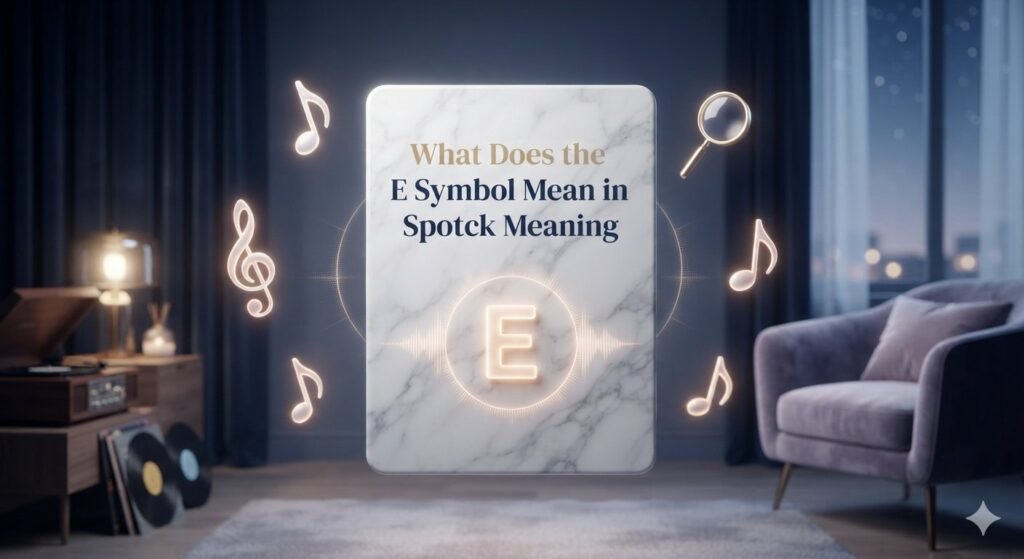
The E symbol on Spotify means that a song or piece of content is marked as explicit.
In simple terms:
- E = Explicit
- It indicates potentially mature or unsuitable content.
- It does not automatically mean the song is violent or sexual.
- Explicit content can include profanity, drug references, sexual themes, or descriptions of violence.
- The label is attached to specific content, not necessarily the entire artist or album.
- A clean or edited version may exist without the E label.
For example, someone might say:
“Why does this song have an E next to it?”
Another person could answer:
“It means the lyrics are explicit.”
Or:
“Try the clean version if you don’t want the uncensored lyrics.”
The important point is that explicit does not mean “bad.” It simply describes the nature of the content.
Origin & Background
The idea behind the E symbol did not begin with Spotify.
Music companies, record labels, retailers, broadcasters, and digital platforms have used different forms of content labeling for decades. One of the most recognizable examples in popular culture is the “Parental Advisory: Explicit Content” label associated with recorded music.
As music moved from physical albums to digital platforms, content warnings had to become much more practical.
Instead of placing a large warning sticker on a CD case, streaming services could use a small visual marker beside a track. That made it possible for listeners to identify explicit material quickly without interrupting the listening experience.
Spotify adopted this approach as streaming became a normal part of everyday life.
The cultural meaning of explicit music has also changed.
In earlier decades, profanity or controversial lyrics could generate significant controversy. Today, explicit language is common across hip-hop, rap, pop, rock, R&B, metal, comedy, podcasts, and other forms of entertainment.
Social media has pushed this evolution even further.
A short lyric can become a TikTok sound, Instagram caption, meme, or viral video within hours. A song that contains strong language may become familiar to millions of people who have never listened to the complete track.
That makes the E label more useful than it might seem.
It gives people a quick piece of context before they press play.
At the same time, the symbol has developed a psychological effect. Some listeners see “E” and become more curious because they expect the song to be raw, rebellious, provocative, or emotionally intense.
For others, it immediately signals, “This isn’t something I want playing around children or at work.”
The same symbol can therefore create completely different reactions depending on the listener.
Real-Life Conversations
1. WhatsApp Conversation
Person A:
“What’s that little E beside the song?”
Person B:
“Explicit lyrics.”
Person A:
“Ohhh. I thought it meant it was an exclusive track 😂”
Person B:
“Nope. Spotify is basically saying, ‘Listen at your own discretion.’”
This is a common misunderstanding because the letter appears small and Spotify does not always explain it directly on the screen.
2. Instagram DM
Person A:
“I sent you that song but don’t play it around your little brother 😭”
Person B:
“Why?”
Person A:
“It’s marked E. Some of the lyrics are definitely not family-friendly.”
Person B:
“Got it 😂 I’ll use headphones.”
Here, the label becomes part of everyday social etiquette. Instead of explaining every lyric, the sender uses the E symbol as a quick warning.
3. TikTok Comments
Person A:
“Why is this song marked explicit? I don’t hear anything that bad.”
Person B:
“Sometimes it’s just one word in the whole song.”
Person A:
“Seriously?”
Person B:
“Yep. One explicit lyric can be enough for the track to receive the label.”
This illustrates why the E symbol should not be interpreted as meaning that an entire song is inappropriate.
4. Text Message
Person A:
“Can you send me the clean version?”
Person B:
“Sure. The original has the E symbol.”
Person A:
“Thanks. Need it for the school event.”
Person B:
“Yeah, definitely use the clean edit for that.”
The same song can therefore have different versions for different environments.
Emotional & Psychological Meaning
The E symbol itself does not express an emotion.
However, people can emotionally interpret it in different ways.
For some listeners, explicit music feels more authentic. Strong language can make lyrics sound less polished and more emotionally honest, especially when an artist is describing anger, heartbreak, frustration, social inequality, relationships, or difficult experiences.
For another listener, the same language may feel aggressive, uncomfortable, immature, or unnecessary.
This is where communication psychology becomes interesting.
Words do not exist in isolation. We interpret them through context, relationship, culture, age, and personal experience.
A swear word between close friends may feel playful. The same word from a manager during a meeting could feel disrespectful.
Music works similarly.
An explicit lyric in an emotional song might communicate vulnerability or anger. In a comedy track, it may create humor. In a confrontational rap song, it might strengthen the artist’s sense of confidence or defiance.
I have often found that people focus too much on the label and not enough on the context.
Imagine recommending a powerful song to a friend because its lyrics perfectly describe what they are going through. You see the E symbol, but you know the song is emotionally meaningful rather than simply provocative.
That distinction matters.
The label tells you what type of content may be present. It does not tell you how you should feel about it.
Usage in Different Contexts
Social Media
On TikTok, Instagram, YouTube, and other platforms, people often share songs without mentioning whether they are explicit.
The Spotify E label provides a quick visual clue.
If someone posts a song lyric publicly, however, the label does not automatically make the language appropriate for every audience. Parents, employers, schools, and brands may still have different standards.
Friends & Relationships
Among friends, the E symbol is usually casual information.
Someone might say, “This song is explicit, but you’ll love it.”
In relationships, music can also carry emotional meaning. An explicit song may be shared because its lyrics communicate feelings that are difficult to say directly.
Work & Professional Settings
Professional environments require more caution.
An explicit song may be perfectly acceptable in someone’s private headphones but inappropriate for a shared office, business event, reception area, or customer-facing environment.
When music is played publicly, consider the audience rather than assuming everyone shares your preferences.
Casual vs. Serious Tone
In casual conversation, people may simply say:
“It’s an E song.”
In a more formal setting, “explicit content” is clearer and more professional.
The difference is not about correctness. It is about choosing language that matches the situation.
When NOT to Use It
The E symbol itself is not something you normally “use” in conversation. The issue is when you rely on the label without considering context.
Avoid assuming that an E-marked song is automatically inappropriate for every person.
At the same time, don’t assume that it is harmless just because you personally are comfortable with explicit language.
Be particularly careful in:
- Schools and children’s events
- Family-friendly public spaces
- Professional presentations
- Religious or culturally sensitive environments
- Weddings and formal ceremonies
- Workplace playlists
- Content intended for young audiences
Cultural sensitivity also matters.
Attitudes toward profanity, sexuality, violence, and references to drugs vary considerably around the world. A phrase that sounds relatively mild to one audience can be deeply offensive to another.
The safest approach is simple: know your audience.
Common Misunderstandings
“E means the song is bad.”
Not necessarily.
The E label describes content, not artistic quality. Some critically respected and culturally important songs contain explicit material.
“Every lyric in the song is inappropriate.”
No.
A track can receive an explicit label because of a relatively small part of its lyrics.
“The E means the artist is explicit.”
No.
The label applies to particular content. An artist can have both explicit and clean songs.
“Explicit means sexual.”
Not always.
Explicit content can involve profanity, violence, drug references, sexual themes, or other mature subjects.
“If I see no E, the song is completely harmless.”
This is also an unsafe assumption.
Content labeling is useful, but it does not replace your own judgment. A song without an E label can still contain themes that a particular listener considers disturbing, controversial, or inappropriate.
“The E is a music rating.”
Not exactly.
It is better understood as a content indicator rather than a quality or age rating.
Comparison Table
| Expression / Label | Meaning | Typical Context | Tone |
|---|---|---|---|
| E / Explicit | Contains mature or explicit content | Streaming platforms | Informational |
| Clean | Edited to remove or alter explicit material | Radio, family settings, playlists | Family-friendly |
| Uncensored | Original content without edits | Music and media | Direct |
| Mature | Intended for older audiences | Entertainment | Formal |
| NSFW | Not safe for work | Internet and social media | Informal warning |
| Family-friendly | Generally suitable for broad audiences | Public/family settings | Positive |
| 18+ | Intended for adults | Age-restricted content | Strong warning |
| PG / parental guidance | Some content may require discretion | Film and entertainment | Cautious |
| SFW | Safe for work | Online communication | Informal reassurance |
| Clean version | Edited alternative to explicit content | Music streaming | Neutral |
Key Insight
The E symbol is best understood as a heads-up, not a judgment. It tells you to expect explicit material, but it does not tell you whether the song is good, bad, meaningful, offensive, funny, or emotionally powerful.
Variations / Types
There are several ways explicit and edited content can appear across music platforms.
1. E — Explicit
The standard E indicator signals that the content contains explicit material.
2. Explicit Version
This usually refers to the original recording containing the uncensored lyrics or mature content.
3. Clean Version
A clean version has been edited to reduce or remove explicit language.
4. Radio Edit
A radio edit is a version modified for broadcasting standards, often removing profanity or other potentially unsuitable material.
5. Censored Version
This version deliberately removes, masks, replaces, or silences certain words or phrases.
6. Uncensored Version
An uncensored version preserves the original wording and content rather than replacing explicit sections.
7. Instrumental Version
The vocals are removed, leaving primarily the musical arrangement.
8. Extended Version
An extended version contains additional musical material or a longer arrangement. It may or may not be explicit.
9. Remix
A remix changes or restructures the original recording. Its content classification can differ from the original track.
10. Edited Album
An album can have a clean edition containing edited versions of songs that appear as explicit on the original release.
One important detail is that not every variation will appear on Spotify with exactly the same wording or visual treatment. The availability and labeling of versions can depend on how the music was delivered to the platform.
How to Respond When Someone Uses It
If someone tells you a song has an E label, your response can be as simple as the situation requires.
Casual Replies
- “Got it.”
- “No worries.”
- “I’ll listen with headphones.”
- “Thanks for the warning.”
Funny Replies
- “Ah, so Spotify has entered parental mode 😂”
- “The tiny E has spoken.”
- “Okay, headphones it is 😂”
- “Noted. Definitely not playing that at Sunday dinner.”
Mature Replies
- “Thanks for letting me know. I’ll check the lyrics first.”
- “That’s helpful. I’ll use the clean version.”
- “Understood. I’ll keep the audience in mind.”
Respectful Replies
- “Thanks for the heads-up.”
- “I appreciate the warning.”
- “I’ll choose an appropriate version for the setting.”
The best response depends less on the E itself and more on why the person mentioned it.
Regional & Cultural Usage
The meaning of the E label is relatively consistent internationally, but attitudes toward explicit content are not.
Western Culture
In the United States, Canada, the UK, Australia, and other Western markets, explicit language is common across popular music.
Hip-hop and rap have played a major role in normalizing strong language as a form of storytelling, identity, humor, protest, and emotional expression.
Even so, people still distinguish between private listening and public settings.
Asian Culture
Across Asian cultures, attitudes can vary enormously because Asia includes many countries, languages, religions, and social traditions.
Some younger internet users may treat explicit music casually, while families and institutions may place greater emphasis on age appropriateness and social expectations.
The same song can therefore be popular among young adults while still being considered unsuitable for children or formal environments.
Middle Eastern Culture
In many Middle Eastern communities, sensitivity around sexual language, profanity, religion, and other mature themes can be considerably stronger than in some Western entertainment environments.
However, attitudes differ between countries, generations, individuals, and online communities.
It is better to avoid making assumptions about an entire region.
Global Internet Usage
The internet has created a shared vocabulary.
Terms such as explicit, clean, uncensored, NSFW, and 18+ can now be understood across many language communities.
But shared terminology does not mean shared cultural standards.
A global audience can understand the warning while interpreting the content very differently.
Gen Z vs. Millennials
Generational differences are also noticeable.
Gen Z tends to encounter content labels constantly across social platforms, streaming services, games, and online communities. As a result, an E symbol may feel almost routine.
Millennials may associate explicit labeling more strongly with CDs, parental advisory stickers, radio edits, and the transition from physical music to digital streaming.
Neither generation has one universal attitude.
The biggest difference is often how familiar they are with digital content labeling, rather than whether they approve of explicit language.
Is It Safe for Kids?
The E symbol itself is harmless. It is simply a content indicator.
The more important question is whether the content behind the label is appropriate for a particular child.
Parents and caregivers should consider the child’s age, maturity, the song’s lyrics, and the themes involved.
A child listening to music with an E label is not necessarily being exposed to dangerous material, but the label is a useful reminder to check the content rather than assuming it is child-friendly.
Spotify and other streaming services also offer parental and content-control features that families can consider when creating listening environments for children.
FAQs
What does the E symbol mean on Spotify?
The E symbol on Spotify generally means Explicit. It indicates that the track contains mature content such as profanity, sexual references, violence, or drug-related language.
Does E mean the song is inappropriate?
Not necessarily. It means the song contains explicit material, but whether that material is inappropriate depends on the listener, age, culture, and situation.
Does E mean the song contains swear words?
Often, yes, but not always. Explicit labeling can also relate to sexual themes, violence, drug references, or other mature content.
Why does one version of a song have E and another does not?
The E-marked version is usually explicit, while the other may be a clean or edited version with certain lyrics changed, removed, or censored.
Can children listen to songs with an E symbol?
They can technically encounter them, but parents should decide whether the content is suitable based on the child’s age, maturity, and family standards.
Is the E symbol a rating?
No. It is primarily a content indicator, not a judgment of a song’s quality or a universal age rating.
Can an explicit song still have a positive message?
Absolutely. Explicit language and positive or meaningful themes can exist in the same song. The E label describes the content, not the overall message or artistic value.
Conclusion
So, what does the E symbol mean in Spotify? It means Explicit. That small letter is Spotify’s quick way of telling you that a track contains material that may not be suitable for every listener or every setting. But the most useful lesson is not simply to memorize what E stands for. It is to understand what content labels can and cannot tell us. The E does not say that a song is bad. It does not tell you how to feel about the artist. It does not mean every line is offensive. And it certainly does not replace personal judgment.
Think of it as a quiet warning before the music begins: “There may be mature content here.” From there, the decision belongs to you. Whether you’re making a playlist for a road trip, choosing music for a family gathering, sending a song to a friend, or simply wondering about that tiny symbol on your screen, knowing what it means helps you make a more informed choice. And sometimes, understanding one small symbol is enough to prevent a very awkward song from playing at exactly the wrong moment.
Discover more post
Mean of Sample Symbol What Does x̄ Mean in Statistics?2026
What Does the SS Symbol Mean?2026
What Does the Red Airbag Symbol Mean? 2026

Mark Twain is a seasoned content writer and digital media expert with 5+ years of experience producing insightful, reader-first content across the web. He specializes in decoding symbols, text abbreviations, emojis, internet slang, Unicode characters, and evolving digital communication trends. As a core contributor at SymbolSignn, Mark is committed to publishing thoroughly researched, accurate, and easy-to-follow content that helps readers quickly understand modern online language. His expertise in SEO and user-focused writing allows him to transform complex topics into engaging, practical guides. By staying ahead of emerging internet trends, Mark ensures every article delivers reliable information, exceptional value, and an enjoyable reading experience for a global audience.