Have you ever received a message containing a simple dash (-) and wondered what the person actually meant? Maybe someone replied with instead of a sentence. Perhaps you saw a dash in a text such as “I thought you were coming but you never showed up.” Or you noticed people using dashes differently on social media, in emails, and in everyday messages.
So, what does the dash symbol mean? The answer depends heavily on which dash is being used, where it appears, and the tone of the conversation. A dash can connect words, separate numbers, introduce an interruption, create dramatic emphasis, or even communicate hesitation in a text message.
This is why the symbol can be surprisingly confusing. In traditional English writing, punctuation has fairly established rules. Online communication is different. People often use punctuation emotionally, and a dash can become part of someone’s personal writing style. Understanding that difference can help you interpret messages more accurately—and use the symbol with confidence yourself.
What Does the Dash Symbol Mean? – Quick Meaning
In general, a dash is a punctuation mark used to create separation, interruption, emphasis, or a break in thought.
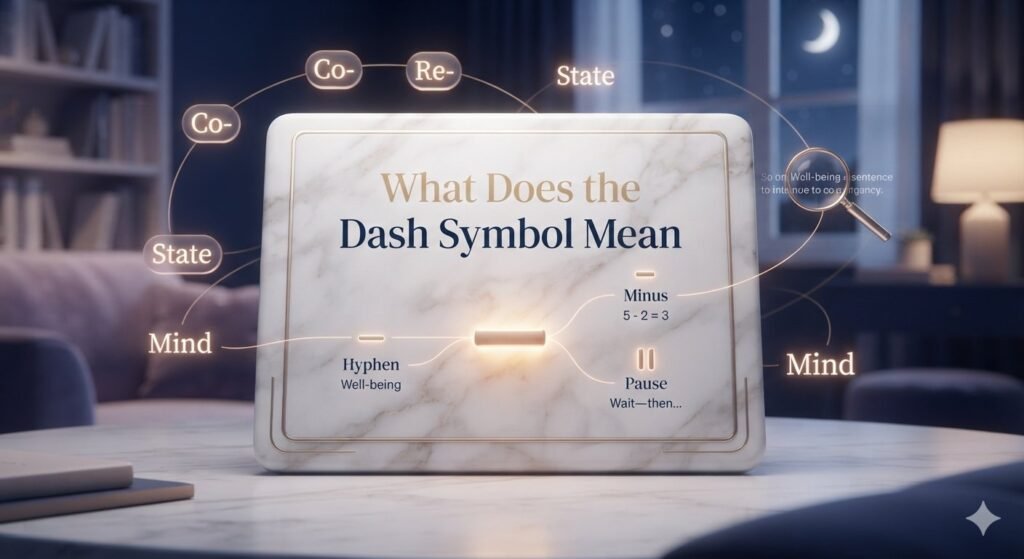
However, there is more than one type of dash.
- Hyphen (-): Usually joins words or parts of words.
- En dash (–): Commonly shows a range or connection.
- Em dash (—): Creates a strong pause, interruption, or change in thought.
- Minus sign (−): Used mathematically to indicate subtraction or a negative number.
For example:
“She is a well-known writer.”
Here, the short mark is a hyphen.
“The meeting is from 9–11 a.m.”
Here, the en dash indicates a range.
“I wanted to call you—but I changed my mind.”
Here, the em dash creates a noticeable pause or shift.
In texting, a standalone dash can also carry a conversational meaning:
“—”
Depending on the situation, it may suggest hesitation, an unfinished thought, awkwardness, or simply a brief response.
Origin & Background of the Dash
The history of the dash is tied to the development of written punctuation itself.
Early writing did not use punctuation in the highly standardized way modern English does. As printed books became more common, writers and printers developed marks that helped readers understand pauses, relationships between words, and changes in thought.
The em dash eventually became particularly useful for showing a sudden break or interruption.
Its name comes from typography. An em is a traditional typographic unit roughly related to the width of the letter “M” in a particular typeface and size. The en dash is approximately half that width.
The distinction may sound technical, but its practical effect is simple: different dash lengths developed different jobs.
Language culture also influenced how dashes were perceived.
In formal writing, the em dash can feel dramatic or literary. In newspapers, novels, essays, and opinion writing, it can guide the reader’s attention without requiring a full stop.
Social media changed things again.
On platforms such as Instagram, TikTok, X, and messaging apps, punctuation is no longer only about grammar. It can communicate personality.
A person may use “—” because it feels cleaner than parentheses. Someone else may use “…” because they want to sound hesitant. Another person might use a dash to create a deliberately sharp or humorous pause.
As digital communication became faster, punctuation began carrying emotional information as well as grammatical information.
Real-Life Conversations
The meaning of a dash becomes much easier to understand when you see it in ordinary conversations.
WhatsApp Conversation
Person A:
Are you still coming tonight?
Person B:
I want to—but honestly, I’m exhausted.
Person A:
Haha, fair enough.
Here, the em dash signals a change in thought. Person B begins positively but immediately qualifies the statement.
Instagram DM
Person A:
You actually posted that photo 😂
Person B:
I warned you—I have no shame.
The dash gives the second sentence a playful pause. It makes the response feel more conversational.
TikTok Comments
Person A:
I thought this was going to be another cooking video—
Person B:
Same 😭
In this context, the dash can create suspense. The writer leaves the thought hanging, often because the next moment in the video surprised them.
Text Messages
Person A:
So you’re saying you forgot my birthday?
Person B:
No—I mean—I remembered it was this week.
The dashes reproduce the feeling of someone trying to explain themselves under pressure.
Notice something important: the punctuation does not have one universal emotional meaning.
Context determines interpretation.
Emotional & Psychological Meaning
A dash can make writing feel more like speech.
When people talk, they naturally pause, restart sentences, interrupt themselves, change direction, and emphasize certain words. An em dash can reproduce some of those patterns on a screen.
For example:
“I thought you were angry.”
feels straightforward.
“I thought you were angry—but maybe I misunderstood.”
feels more reflective.
And:
“I thought you were angry—”
feels unfinished.
That unfinished quality can create tension or invite the reader to imagine what comes next.
In personal communication, a dash may therefore suggest:
- Hesitation
- Surprise
- Emotional tension
- Interruption
- Emphasis
- A change of direction
- An unfinished thought
- Dramatic timing
There is also a psychological reason people gravitate toward it: the dash gives writers flexibility.
It allows someone to express a complicated thought without making every sentence perfectly formal.
I have seen this distinction matter particularly in personal messages. A sentence with an em dash can feel like someone is thinking aloud rather than delivering a carefully prepared statement.
That can make the message feel more intimate.
At the same time, the reader’s interpretation matters. Someone who normally writes very formally may use a dash purely for grammar, while another person may use it to signal emotion.
Usage in Different Contexts
Social Media
Dashes are extremely common in captions, comments, and posts.
They can create rhythm, emphasis, suspense, or a conversational voice.
For example:
“Three things I learned this year—none of them were easy.”
The dash introduces the important second part of the thought.
On social platforms, the em dash can also make writing look more polished without making it sound excessively formal.
Friends and Relationships
In personal conversations, dashes often reproduce natural speech.
For example:
“I wasn’t ignoring you—I was driving.”
The dash connects two thoughts while making the second one feel like an immediate clarification.
In emotional conversations, however, be careful.
A message such as:
“Fine—I understand.”
may sound irritated even if you did not intend it that way.
Work and Professional Settings
Dashes are perfectly acceptable in professional writing when used correctly.
For example:
“Please review the attached report—the final section contains the updated figures.”
However, excessive punctuation can make business communication feel informal or dramatic.
In highly formal documents, clarity should come first. If a comma, colon, semicolon, or full stop communicates the idea more clearly, use it.
Casual vs. Serious Tone
A dash can work beautifully in casual writing because it mirrors speech.
In serious writing, it can also be effective, but intentionality matters.
Compare:
“The decision was difficult—but necessary.”
with:
“The decision was difficult. However, it was necessary.”
The first feels more immediate and emphatic. The second feels more formal and detached.
When NOT to Use It
A dash is versatile, but it is not appropriate everywhere.
Avoid using an em dash simply because you are unsure where another punctuation mark belongs.
In professional or academic writing, excessive dashes can make sentences difficult to follow.
You should also be careful when communicating across cultures.
Some readers interpret punctuation literally, while others interpret it emotionally. A dash that feels casual to you might look abrupt or unfinished to someone else.
A standalone dash can be particularly confusing:
Person A:
Did you speak to Sarah?
Person B:
—
Without additional context, the reader has to guess whether the person is thinking, refusing to answer, expressing awkwardness, or simply sending an accidental character.
In sensitive conversations, clarity is usually better than ambiguity.
Common Misunderstandings
“A dash always means something negative.”
Not true.
A dash can express contrast, emphasis, explanation, suspense, interruption, or simply a stylistic pause.
“All dashes are the same.”
Technically, no.
The hyphen, en dash, and em dash have different functions.
“A dash means someone is angry.”
Not necessarily.
In text messages, punctuation can influence perceived tone, but the meaning depends on the words surrounding it.
“A dash is just a longer hyphen.”
Visually they may look similar, but their grammatical roles differ.
A hyphen joins words:
“high-quality”
An en dash often indicates a range:
“2019–2024”
An em dash can separate an interruption or parenthetical thought:
“She agreed—eventually.”
“A standalone dash has one fixed meaning.”
It doesn’t.
In digital conversations, a standalone “-” or “—” can be highly context-dependent.
Comparison Table
| Symbol / Expression | Main Meaning | Common Use | Example |
|---|---|---|---|
| – Hyphen | Joins words | Compound words | well-known |
| – En dash | Shows range or connection | Dates, numbers, relationships | 2020–2026 |
| — Em dash | Strong pause or interruption | Prose, emphasis, dialogue | I tried—but failed. |
| − Minus sign | Mathematical subtraction | Mathematics | 10 − 4 |
| … Ellipsis | Unfinished thought or pause | Casual writing | I don’t know… |
| — Standalone em dash | Context-dependent pause | Digital conversation | “—” |
| … Three-dot pause | Hesitation or trailing thought | Texting | Maybe… |
| **: ** Colon | Introduces explanation/list | Formal and informal writing | Remember this: practice. |
| ; Semicolon | Connects related clauses | Formal writing | I called; nobody answered. |
Key Insight
The biggest difference is purpose. A hyphen usually connects, an en dash often indicates a range, and an em dash creates a stronger break in thought. In online conversation, however, punctuation can also carry emotion and personality.
Variations / Types
1. Hyphen (-)
The hyphen is the shortest and most familiar mark.
It normally connects words or word parts, as in “part-time,” “self-aware,” or “well-known.”
2. En Dash (–)
The en dash is commonly used to express a range.
For example, “pages 10–20” means pages 10 through 20.
3. Em Dash (—)
The em dash creates a stronger interruption or pause.
Example: “She finally arrived—but the meeting was already over.”
4. Standalone Em Dash (—)
When used alone in digital communication, its meaning depends almost entirely on context.
It can suggest silence, hesitation, interruption, or an unfinished response.
5. Repeated Dashes (— —)
Multiple dashes may be used stylistically to create dramatic spacing or indicate a break.
This is more common in informal digital writing than formal prose.
6. Dash Before a Correction
A dash can introduce an immediate clarification.
Example: “I’ll arrive at eight—actually, make that eight-thirty.”
7. Dash for Dramatic Emphasis
A writer can use an em dash to make the next phrase stand out.
Example: “There was only one problem—the key was missing.”
8. Dash for Interruption
In dialogue, an em dash can represent someone being cut off.
Example:
“I was going to tell you—”
“Forget it.”
9. Dash for an Abrupt Change
The mark can signal a sudden change in direction.
Example: “I trusted him completely—until I discovered the truth.”
10. Dash in Number Ranges
An en dash can connect two numbers or dates.
Example: “The course runs from September 4–18.”
How to Respond When Someone Uses It
If someone uses a dash in a message, don’t automatically assume it has a hidden meaning.
Look at the whole sentence first.
Casual Replies
You can respond naturally:
“Yeah, I get you.”
“Okay, that makes sense.”
“Fair enough 😂”
Funny Replies
If the conversation is playful:
“Dramatic pause detected 😂”
“Okayyy, what happened after the dash?”
“That’s a suspicious dash…”
Mature Replies
When the conversation is serious:
“I understand what you’re saying.”
“Take your time. I’m listening.”
“I think I understand your point.”
Respectful Replies
If you’re uncertain about someone’s meaning:
“Just to make sure I understood you correctly, do you mean…?”
This is often the best response when punctuation makes the tone unclear.
Don’t build an entire emotional interpretation around a single symbol.
Regional & Cultural Usage
Punctuation is increasingly global, but communication habits still vary between cultures and generations.
Western Culture
In American and British English, the em dash is widely recognized as a punctuation mark used for interruption, emphasis, or a change in thought.
In casual online communication, it can also be used stylistically.
Asian Culture
English-language communication across Asian countries can combine local communication conventions with English punctuation.
The dash itself generally retains its grammatical functions, but the emotional interpretation may depend more strongly on context, relationship, and platform.
A short or incomplete response can sometimes be interpreted differently depending on local messaging norms.
Middle Eastern Culture
English is widely used in professional, educational, and online settings throughout the Middle East.
Again, the grammatical meaning of the dash remains largely consistent, but interpersonal interpretation depends on the relationship between speakers and the surrounding language.
In multilingual conversations, punctuation can become especially useful because it helps divide thoughts when people are switching between languages.
Global Internet Usage
Internet culture has made punctuation much more expressive.
People use dashes to imitate speech, create suspense, make jokes, and control the rhythm of a message.
A dash can almost function like a small stage direction: pause here; pay attention to what comes next.
Gen Z vs. Millennials
Generational differences are more noticeable in digital punctuation than in formal grammar.
Gen Z and younger internet users may deliberately manipulate punctuation to communicate irony, humor, awkwardness, or emotional distance.
Millennials may also use these conventions, but some readers associate traditional punctuation with more formal communication.
Neither interpretation is universal.
The safest approach is to consider the person’s usual writing style rather than assigning meaning based solely on age.
Is It Safe for Kids?
Yes. The dash itself is simply a punctuation mark and is not inherently harmful.
The important issue is context.
Children may encounter dashes in schoolwork, books, social media, games, and messaging. Teaching them that punctuation can have both grammatical and conversational functions helps them understand written communication more confidently.
For younger children, it is useful to focus first on the basic distinction between a hyphen, en dash, and em dash.
As they become more familiar with digital communication, they can learn that punctuation sometimes affects perceived tone.
FAQs
1. What does the dash symbol mean in texting?
In texting, a dash can indicate a pause, interruption, hesitation, emphasis, or change in thought. Its exact meaning depends on the surrounding message.
2. What does a single dash mean in a message?
A single dash has no universal conversational meaning. It may indicate silence, hesitation, an unfinished thought, or simply be a stylistic response.
3. Is a dash the same as a hyphen?
No. A hyphen joins words, while an en dash and em dash serve different punctuation functions.
4. What does “—” mean in English?
The em dash “—” usually creates a strong break, interruption, emphasis, or shift in thought within a sentence.
5. Why do people use dashes instead of commas?
An em dash creates a stronger pause than a comma. Writers often choose it when they want an interruption, contrast, or important phrase to stand out.
6. Does a dash mean someone is angry?
Not necessarily. A dash can affect tone, but it does not automatically indicate anger. The words, relationship, and context matter more.
7. Which dash should I use in formal writing?
Use the punctuation mark that matches your purpose. Hyphens join words, en dashes commonly indicate ranges, and em dashes create strong breaks or interruptions.
Conclusion
So, what does the dash symbol mean? The simplest answer is: it depends on the dash and the context. In traditional English, different dash marks have different grammatical jobs. A hyphen connects words, an en dash commonly expresses a range, and an em dash creates a powerful break or interruption. But modern communication has added another layer. On WhatsApp, Instagram, TikTok, and text messages, punctuation is no longer purely mechanical. A dash can reproduce the pause in someone’s voice, make a joke land harder, create suspense, or show that a thought is changing while the person writes it.
That is why understanding punctuation isn’t only about memorizing grammar rules. It is also about understanding people. When you see a dash in a message, read the whole sentence, the relationship, and the situation before deciding what it means. And when you use one yourself, use it intentionally. The right dash can make a sentence sound natural, confident, and unmistakably human.
Discover more post
Mean of Sample Symbol What Does x̄ Mean in Statistics?2026
What Does the SS Symbol Mean?2026
What Does the Red Airbag Symbol Mean? 2026

Kate Chopin is an experienced content writer and digital content specialist with 7+ years of expertise in creating clear, engaging, and well-researched articles. She has a strong passion for explaining internet slang, text abbreviations, emojis, symbols, and the latest social media trends in a way that’s easy for everyone to understand. Her writing is driven by accuracy, simplicity, and a commitment to delivering reliable information that readers can trust. Over the years, Kate has helped thousands of users navigate the ever-changing world of online communication through practical, reader-friendly content. At SymbolSignn.com, she continues to simplify modern digital language and internet culture with informative guides designed for everyday users.