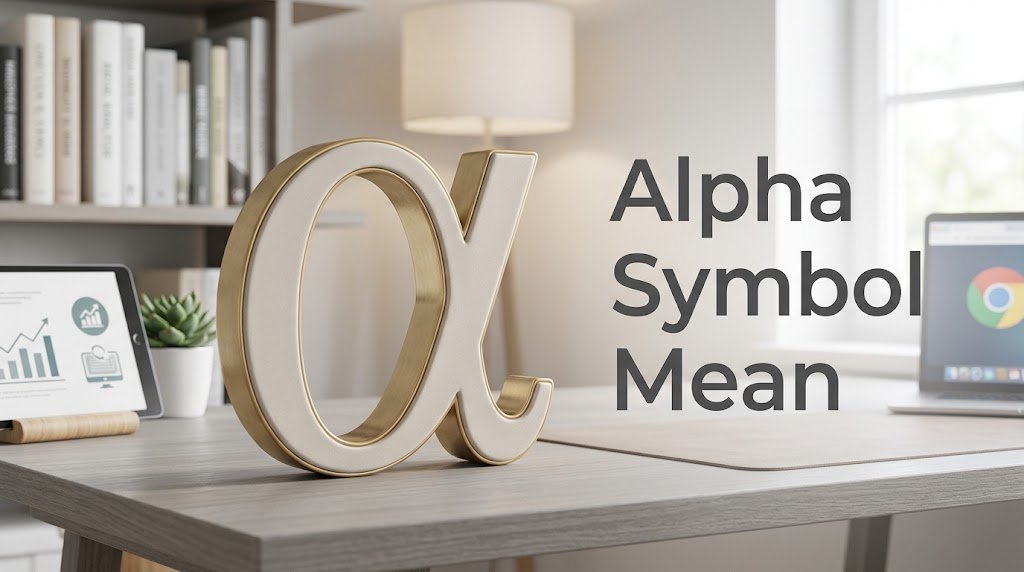
If you have ever seen α in a message, Instagram bio, scientific formula, Greek text, or social media post, you may have wondered: what does the alpha symbol mean? The answer depends heavily on context.
The symbol α is the lowercase form of the Greek letter alpha, while Α is its uppercase form. In mathematics and science, alpha can represent an angle, coefficient, particle, or other variable. In language and culture, “alpha” can suggest being first, leading, dominant, or highly influential.
That is why a simple symbol can create confusion. Someone using α in a physics equation is not making a statement about personality. Someone calling themselves an “alpha” online may be talking about confidence, leadership, status, or an idealized image of masculinity.
Understanding the context is therefore more important than memorizing one definition.
What Does the Alpha Symbol Mean? – Quick Meaning
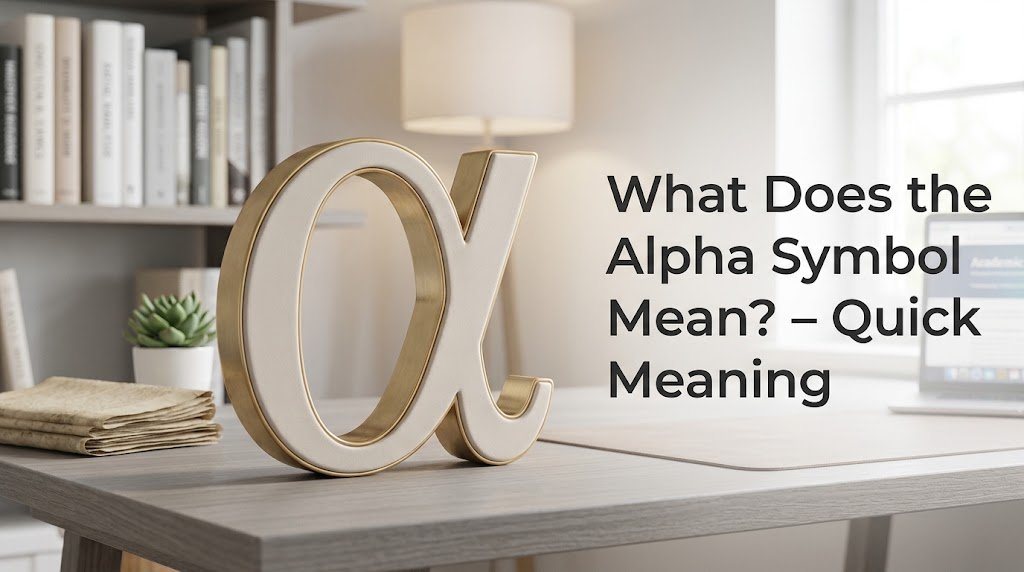
At its most basic level, alpha (α) is the first letter of the Greek alphabet.
Depending on where you encounter it, it can mean:
- First or beginning — because alpha comes first in the Greek alphabet.
- A symbol in mathematics — often used for angles, constants, coefficients, or variables.
- A scientific notation — for example, alpha particles or alpha radiation.
- Leadership or dominance — particularly in everyday expressions such as “alpha personality.”
- A high-ranking or primary position — especially in business, technology, and online communities.
Here are a few everyday examples:
“She has an alpha personality.”
This usually means she is perceived as confident, assertive, or naturally inclined to lead.
“Find α in the equation.”
Here, α is simply a mathematical variable.
“He calls himself an alpha.”
In social conversation, this may refer to confidence, social status, masculinity, or dominance rather than the Greek letter itself.
The important lesson is simple: α does not have one universal meaning. Context determines its meaning.
Origin & Background
The word alpha comes from the Greek letter alpha (άλφα), the first letter of the Greek alphabet. Greek itself inherited the letter from earlier writing traditions, ultimately connected to the ancient Semitic letter aleph.
Its position as the first Greek letter helped give “alpha” a broader symbolic association with beginnings and priority.
This is where expressions such as “alpha and omega” became culturally powerful. Alpha represents the beginning, while omega, the final Greek letter, represents the end.
Over centuries, Greek letters became deeply embedded in mathematics, philosophy, medicine, astronomy, engineering, and the sciences.
As a result, α can now appear in places that have nothing to do with personality or social status.
The modern cultural meaning of “alpha” developed along a different path. In popular discussions of animal behavior during the 20th century, the term became associated with dominant individuals within social groups.
That idea eventually entered everyday language.
Today, “alpha male,” “alpha female,” and “alpha personality” are common expressions online. However, these terms are often much more simplistic than the scientific research that originally influenced them.
Social media has amplified the cultural meaning.
On TikTok, Instagram, YouTube, and other platforms, “alpha” may be used seriously, ironically, humorously, or as part of motivational content. A person might describe someone as alpha because they appear confident, independent, ambitious, or unwilling to follow a crowd.
Another person might use the same word sarcastically to make fun of exaggerated displays of confidence.
That shift is important: internet language often turns established words into flexible social signals.
Real-Life Conversations
WhatsApp Conversation
Person A:
“Why did you put α in your bio?”
Person B:
“It means alpha. I wanted it to represent being the first version of yourself.”
Person A:
“Oh, I thought it was some science thing 😂”
Person B:
“Honestly, it can be both.”
The exchange shows how symbols can become personal branding. The meaning is not necessarily fixed by a dictionary.
Instagram DM
Person A:
“You have such an alpha vibe in that picture.”
Person B:
“Do you mean confident or bossy? 😂”
Person A:
“Confident! Like you know exactly what you’re doing.”
Person B:
“Okay, I’ll take that as a compliment.”
Here, “alpha” is describing perceived personality rather than the Greek alphabet.
TikTok Comments
Person A:
“Bro really thinks he’s alpha 💀”
Person B:
“He walked away from the drama. That’s actually confidence.”
Person A:
“Fair point 😂”
This is a good example of modern internet usage. “Alpha” can be used ironically, especially when people are mocking exaggerated ideas of dominance.
Text Messages
Person A:
“My professor wrote α on the board 20 times.”
Person B:
“Alpha?”
Person A:
“Yep. Apparently every variable today is Greek.”
Here, there is no hidden emotional meaning at all. Alpha is simply a useful symbol in an academic context.
Emotional & Psychological Meaning
When “alpha” is used to describe a person, it usually carries an emotional suggestion of confidence, strength, independence, authority, or social influence.
But there is an important distinction between confidence and dominance.
A confident person may be comfortable expressing an opinion without needing everyone else to agree. A person using “alpha” in a more aggressive sense may associate status with control, competition, or superiority.
That difference explains why the word can feel positive to one person and irritating to another.
Modern communication increasingly relies on short labels to communicate complicated identities. Words such as “alpha,” “introvert,” “leader,” and “independent” can function almost like personality shorthand.
I have seen this kind of misunderstanding happen in ordinary conversations: one person intends “alpha” to mean self-assured, while the listener hears “arrogant.”
That is why tone matters.
A useful psychological insight is that people rarely respond only to the literal word. They also respond to the identity, attitude, and social assumptions they associate with it.
Usage in Different Contexts
Social Media
On social platforms, “alpha” can describe confidence, leadership, attractiveness, independence, or social status.
It can also be deliberately ironic.
The surrounding words, emojis, video, caption, and audience often determine whether the expression is sincere or sarcastic.
Friends & Relationships
Among friends, calling someone “alpha” may be a compliment.
For example, a friend might say, “You were alpha in that meeting,” meaning you remained confident under pressure.
In romantic conversations, however, the word can carry additional implications about gender roles and dominance.
That makes it more sensitive.
Work & Professional Settings
In professional communication, “alpha” is safest when it has a technical or established meaning.
For example, alpha version is widely understood in software development as an early development stage.
Using “alpha” to describe a colleague’s personality can be less appropriate because it may sound judgmental or overly personal.
Casual vs. Serious Tone
In casual conversation, “alpha” can be playful.
In serious communication, explain what you mean rather than assuming the listener shares your interpretation.
“She’s very confident and takes initiative” is usually clearer than “She’s alpha.”
When NOT to Use It
Avoid using “alpha” as a personality label when you do not know how the other person interprets the term.
This is particularly important in workplaces, schools, formal writing, and sensitive conversations.
You should also be cautious when using “alpha” to describe men or women according to rigid gender expectations.
Not every confident man is “alpha,” and leadership does not require dominance.
Cultural sensitivity matters too. Internet communities may use the word casually, but someone unfamiliar with that culture may interpret it as an insult or as a claim of superiority.
Finally, do not assume that α always means alpha personality.
In science, mathematics, medicine, and education, it may have an entirely technical meaning.
Common Misunderstandings
“Alpha always means dominant.”
No. The original Greek letter does not inherently mean dominance. It is simply the first letter of the Greek alphabet.
“α and alpha are always interchangeable.”
Not exactly. Alpha is the word or name, while α is the lowercase Greek symbol. The appropriate form depends on the writing system and context.
“Calling someone alpha is always a compliment.”
No. It can be praise, neutral description, teasing, criticism, or sarcasm.
“Alpha means scientifically proven superiority.”
This is a particularly misleading interpretation. Modern popular culture often uses “alpha” more broadly than scientific terminology justifies.
“The meaning online is always serious.”
Definitely not.
Internet communities frequently use “alpha” humorously, especially when exaggerating stereotypical behavior.
Comparison Table
| Expression | Common meaning | Typical tone | Example |
|---|---|---|---|
| Alpha / α | First, primary, leading, or context-dependent symbol | Neutral to positive | “Alpha is the first Greek letter.” |
| Alpha personality | Confident, assertive, influential | Positive or judgmental | “She has a strong personality.” |
| Leader | Person who guides or influences others | Usually positive | “He’s a natural leader.” |
| Boss | Person with authority; sometimes someone impressive | Casual | “She’s the boss around here.” |
| Sigma | Online slang often associated with independence or nonconformity | Informal/ironic | “He has a sigma mindset.” |
| Beta | Often used online as an opposite to “alpha,” implying less dominant status | Often negative or teasing | “Don’t act so beta.” |
| Dominant | Having greater control, influence, or power | Neutral to negative | “The dominant team controlled the match.” |
| Confident | Having trust in one’s abilities | Generally positive | “She’s confident in her decision.” |
| Assertive | Expressing opinions clearly and firmly | Usually positive | “He was assertive without being rude.” |
| Alpha and omega | Beginning and end; totality | Formal/literary | “From alpha to omega.” |
Key Insight
“Alpha” is more flexible than it looks. The same word can represent a Greek letter, a technical variable, an early product stage, or a social idea about confidence and status. Always read the surrounding context before assigning an emotional meaning.
Variations / Types
1. Alpha Symbol (α)
The lowercase Greek letter used extensively in mathematics, science, and technical writing.
2. Capital Alpha (Α)
The uppercase Greek alpha resembles the Latin capital letter A and is used according to Greek-language and technical conventions.
3. Alpha Personality
An informal description for someone perceived as confident, assertive, influential, or dominant.
4. Alpha Male
A popular cultural expression referring to an allegedly dominant or high-status man, particularly in discussions of masculinity.
5. Alpha Female
A popular expression describing a woman perceived as confident, independent, ambitious, or socially influential.
6. Alpha Version
A very early version of software or a product that is still undergoing development and testing.
7. Alpha Particle
A type of particle associated with certain forms of radioactive decay and consisting of two protons and two neutrons.
8. Alpha Radiation
Ionizing radiation made up of alpha particles, relevant in nuclear science and radiation physics.
9. Alpha Male Slang
Internet language built around ideas of dominance, masculinity, status, or self-improvement.
10. Alpha and Omega
A symbolic expression representing the beginning and the end, derived from the first and last letters of the Greek alphabet.
How to Respond When Someone Uses It
Your response should match the context.
Casual Replies
- “Haha, I’ll take that as a compliment.”
- “You mean confident?”
- “Depends what you mean by alpha.”
Funny Replies
- “Alpha? I thought we were discussing Greek letters. 😂”
- “Should I bring a math textbook?”
- “Very alpha of you to say that.”
Mature Replies
- “If you mean confident and decisive, I understand.”
- “I prefer to think of it as being confident rather than dominant.”
- “I get what you’re saying, although I interpret ‘alpha’ differently.”
Respectful Replies
If you are unsure what someone means, the simplest response is often the best:
“What do you mean by alpha in this context?”
That one question can prevent an unnecessary misunderstanding.
Regional & Cultural Usage
Western Culture
In the United States, Canada, the United Kingdom, Australia, and other Western English-speaking environments, “alpha” is commonly associated with leadership, confidence, masculinity, competitiveness, and social status.
Online culture has made the term particularly visible.
Asian Culture
Across Asian countries, the interpretation varies considerably because “alpha” interacts with local ideas about hierarchy, respect, achievement, and social behavior.
In some contexts, assertiveness may be admired. In others, excessive self-promotion may be viewed less favorably.
Therefore, translating “alpha” directly into a local cultural meaning can be misleading.
Middle Eastern Culture
The word may appear in English-language social media and youth culture, particularly in conversations about confidence, masculinity, relationships, and status.
However, interpretations can differ substantially depending on country, age, language, and community.
The safest approach is to understand the speaker’s intended meaning rather than assume a universal definition.
Global Internet Usage
The internet has created a shared vocabulary that crosses borders.
“Alpha,” “sigma,” “beta,” and related terms can now appear in memes, gaming communities, dating discussions, motivational content, and short-form videos.
Online, irony is especially important. A comment that appears insulting at first glance may actually be deliberately humorous.
Gen Z vs. Millennials
Gen Z internet culture tends to use “alpha” more flexibly, often combining sincere usage with memes and irony.
Millennials may be more likely to encounter the word through self-improvement, business, leadership, or earlier discussions of “alpha males.”
These are broad tendencies, not strict rules. Individual communities matter more than birth year alone.
Is It Safe for Kids?
Yes, the alpha symbol itself is harmless. Children may encounter α in mathematics, science, Greek-language material, or educational content.
The potential concern comes from the social meaning of “alpha.”
Children and young teenagers may encounter online content that connects being “alpha” with dominance, popularity, masculinity, or superiority. Parents and educators can use these moments to discuss the difference between confidence, kindness, leadership, and controlling behavior.
Context is more important than the word itself.
FAQs
1. What does the alpha symbol α mean?
The symbol α is the lowercase Greek letter alpha. Its meaning depends on context and may represent a variable, angle, coefficient, scientific concept, or the idea of “alpha” in popular culture.
2. What does alpha mean in slang?
In slang, “alpha” commonly describes someone perceived as confident, assertive, dominant, influential, or high-status.
3. Is alpha a positive or negative word?
It can be either. “Alpha” may be a compliment meaning confident or capable, but it can also sound arrogant, judgmental, or sarcastic.
4. What does alpha mean on social media?
On social media, “alpha” often refers to confidence, dominance, masculinity, leadership, or status. It may also be used ironically in memes and comments.
5. What is the opposite of alpha?
In popular internet slang, beta is often presented as the opposite of alpha. However, these labels are cultural slang rather than precise measures of personality.
6. What does α mean in mathematics?
In mathematics, α commonly represents a variable, angle, coefficient, parameter, or other quantity. Its exact meaning depends on the equation or field.
7. Is alpha the first Greek letter?
Yes. Alpha is the first letter of the Greek alphabet, which is why it has long been associated symbolically with beginnings, priority, and first position.
Conclusion
So, what does the alpha symbol mean? At its foundation, α is the lowercase Greek letter alpha the first letter of the Greek alphabet. From that simple beginning, the word has developed a remarkable range of meanings. In mathematics and science, it can be a precise technical symbol. In technology, “alpha” can describe an early stage of development. In everyday language, it can suggest confidence or leadership. On social media, it may describe status, masculinity, independence, or simply serve as a joke.
That is why context matters so much. If someone sends you α, look at the conversation around it before deciding what they mean. If they call someone “alpha,” listen for whether they are praising confidence, criticizing arrogance, or simply making a joke. Language becomes easier when you stop treating words as fixed labels and start paying attention to the people using them.
And that is perhaps the most useful lesson behind the alpha symbol: meaning is not just found in the word it is created by context, culture, and human intention.
Discover more post
What Does the SS Symbol Mean?2026
Mean of Sample Symbol What Does x̄ Mean in Statistics?2026
What Does the E Symbol Mean in Spotify? 2026

Dan Brown is a professional content writer and symbolism researcher with over 6 years of experience in decoding symbols, signs, emojis, dreams, colors, and cultural meanings. He specializes in creating well-researched, easy-to-understand, and SEO-friendly content that helps readers discover the true meaning behind everyday symbols. As a lead contributor at SymbolSignn.com, Dan combines extensive research with practical insights to deliver accurate, engaging, and trustworthy articles. His mission is to make complex symbolic meanings simple, reliable, and accessible for readers around the world.